Fifteen-Year-Old Injured by Police Grenade as France’s School Protests Enter Third Week

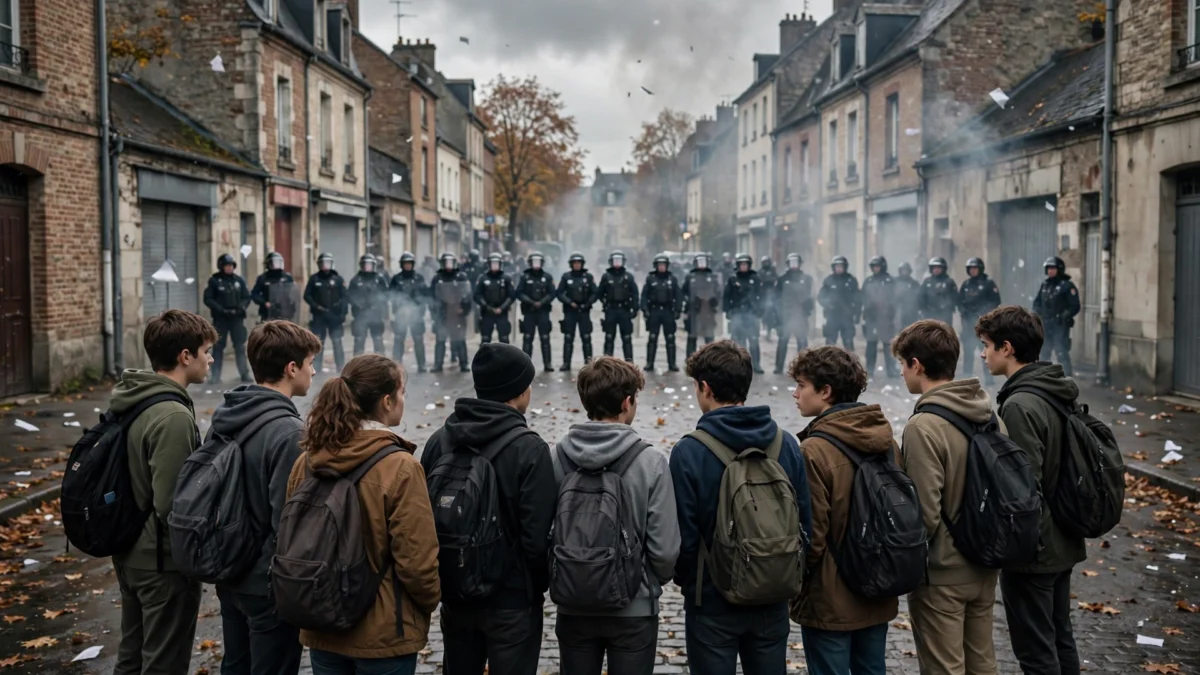
A 15-year-old student was gravely injured on Monday morning when a police grenade detonated in front of a high school in the northern French town of Lens, in the most serious incident yet of a student protest wave now entering its third week.
The boy, a pupil at the Auguste Béhal high school, was rushed to hospital. His life is not in danger, according to François-Xavier Lauch, the prefect of the Pas-de-Calais department. How exactly he came to be hurt is disputed. The regional newspaper La Voix du Nord reported that he picked up a police dispersal grenade that exploded, costing him his hand and part of his lower arm. A police union source quoted by the AFP news agency offered a similar account, saying the teenager appeared to have picked up a sting-ball grenade fired by riot officers. Witnesses quoted in French media disputed that version, and the public prosecutor in Béthune, Etienne Thieffry, said on Monday that he could not yet confirm whether the boy had picked the device up or whether it had landed on him.
Thieffry assigned the case to the IGPN, France’s national police watchdog, for an investigation into “violence resulting in mutilation and permanent disability”. The school switched to distance learning and set up a pupil support unit, French media reported.
The confrontation unfolded around 10 in the morning. According to the prefect, a larger crowd of students than on previous days had gathered outside the school and began throwing stones, fireworks and mortars at local police officers. Riot officers were then deployed. Lens mayor Sylvain Robert said the exact circumstances still needed to be clarified.
The incident came on the eve of a national day of action called by the pupils’ union against chronic underfunding, overcrowded classrooms and crumbling school buildings. On Monday, around 500 schools across France were partially or fully closed. Education Minister Edouard Geffray said in the evening that 190 students had been injured since the protests began, and acknowledged that the most serious injuries appeared to have resulted from law-enforcement interventions. He said the government would open an online platform where students could air their grievances and would launch action plans for individual schools, while also claiming participation in the protests had been declining in recent days.
The movement began in the poor suburbs of Paris and has since spread nationwide, driven by anger over teacher shortages and the state of school infrastructure. Rights groups have accused the police of heavy-handed tactics against minors, including batons, tear gas and rubber-bullet guns. Authorities are also examining the case of a 16-year-old who suffered an eye injury after police fired rubber bullets into a crowd of protesters, according to his friends; the Interior Ministry did not immediately respond to requests for comment.
The unrest is unfolding six months before the election to replace outgoing President Emmanuel Macron, and it has taken on an overtly political character. The government and the far-right National Rally, led by presidential frontrunner Marine Le Pen, have accused hard-left France Unbowed (LFI) lawmakers and mayors of stoking the protests. LFI denies the accusation and accuses the government of politicising the issue. Figures cited in French media say more than 5,000 people have been arrested since the protests began — the large majority of them minors — with more than 1,800 facing prosecution.
Why It Matters
The Lens incident is a threshold moment. A school-funding protest has now produced a mutilated 15-year-old, and that single injury will do more to define the movement than any union statement. It shifts the national argument from dilapidated buildings to the state’s own methods of crowd control against children.
The disputed sequence of events matters enormously. If the investigation concludes the teenager picked the grenade up, the police line will be framed as conventional riot control; if it concludes the device detonated on him, the question of proportionality becomes unavoidable — and the GM2L grenade has a record of maiming, including a protester who lost her thumb in Rouen in 2023. Either way, the IGPN investigation will take weeks, and until then both camps will weaponise the ambiguity.
Watch the politics. With six months to the presidential election and Marine Le Pen the frontrunner, both the government and the far right have an incentive to cast this as a law-and-order crisis rather than a funding failure — while LFI benefits politically from the unrest it is accused of fuelling. Expect the Lens grenade to feature in every campaign argument about policing and youth.
What to watch next: the turnout at the national day of action; whether the education ministry’s promised grievance platform and school-by-school plans defuse the movement or inflame it; and the IGPN’s findings in Lens, which will determine whether this becomes a scandal for the police or a cautionary tale retold by prefects.
Sources
- https://www.lemonde.fr/en/france/article/2026/10/06/high-school-protests-what-we-know-about-injuries-among-demonstrators-and-police_6758279_7.html
- https://www.devdiscourse.com/article/international/3987153-teenagers-hand-blown-off-as-french-school-protests-enter-third-week
- https://foxnews.com/world/teens-hand-blown-off-police-grenade-french-student-protests-report

About the Author — Abdul Mannan
Related Articles
Sánchez Calls Snap Spanish Election for 29 November After Housing Defeat in Parliament
Pedro Sánchez has called a snap general election for 29 November after parliament rejected his housing decrees, gambling…

Two Dead as Fire Engulfs Turkish-Owned Grain Ship Off Romania; Ukraine Blames Russian Drones
Two crew members died and 11 were rescued after a fire on the Turkish-owned grain ship Royad Mammadov…
Flávio Bolsonaro Beats Lula in First Round as Brazil Heads to October 25 Runoff
Right-wing senator Flávio Bolsonaro finished ahead of incumbent President Lula in Brazil's first round on Sunday, defying final…