Three Days Blind: How Ukraine Discovered Its Sky Has an American Switch

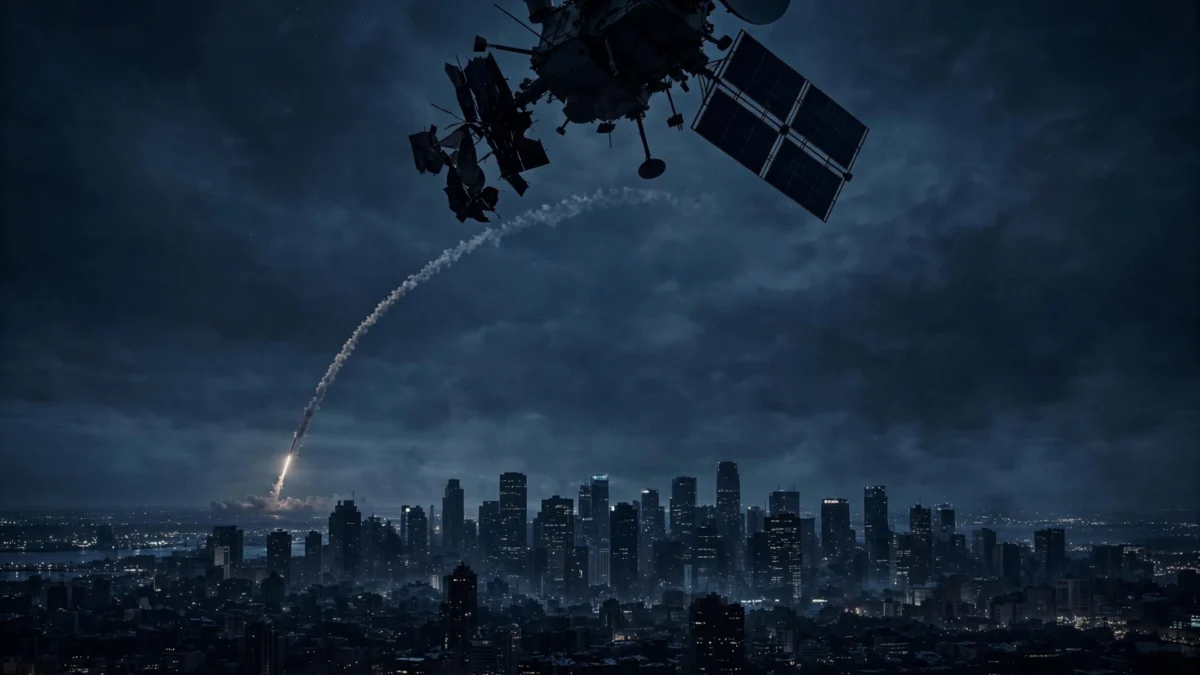
Imagine this. You are asleep in your home in Kyiv. Somewhere above the horizon, a ballistic missile lifts off from Russian soil, climbing through the night at many times the speed of sound. In a normal week, a satellite thousands of miles above the earth sees the flare of its launch, an American analyst notes the coordinates, and within minutes your phone screams an air-raid warning. You have perhaps seven minutes to reach a shelter. That is the difference between the living and the dead in this war — seven minutes, bought and paid for by a warning you never asked to need.
Now imagine that the warning simply does not come. Not because the satellite broke. Not because the analyst slept. But because someone, sitting in an office in Washington, quietly turned off your country’s eyes — for three days — while the missiles kept coming.
On Sunday, October 18, Ukraine’s President Volodymyr Zelensky sat before NBC’s Meet the Press and said it out loud, in that blunt style that so unnerves the polished rooms of power: “It was blocked for some period of time. And then it was de-blocked by the American side. We are very thankful for this. Now it works.” Read that sentence again and let its horror settle. “We didn’t see attacks of Russia using ballistic missiles,” he explained. “Only the United States has this unique intelligence to tell our side when Russia uses ballistic missiles. And we didn’t get it during ballistic attacks during three days.”
Three days blind. Three days in which the sky fell on Ukraine and Washington — its greatest ally, its strategic partner, its self-declared friend — held the switch.
The Second Blinding
Here is what the headlines mostly forgot to tell you, and what you must not forget: this was not the first time. In March 2025, after that explosive Oval Office confrontation between Trump and Zelensky, Washington suspended military aid and intelligence sharing for Ukraine. The lights went out then too — for about a week — until eight hours of talks in Jeddah, Saudi Arabia, on March 11, 2025, produced a 30-day ceasefire offer and the Americans magnanimously switched the eyes back on. The Associated Press recorded it as a triumph of diplomacy. I record it as something darker: the moment it became official policy that an ally’s vision could be rationed like a punishment.
History does not repeat itself, the saying goes, but it rhymes — and this rhyme is seventeen months apart. Each time, the blindness arrives not as an accident but as a message. Each time, it is restored not as a right but as a reward. Ask yourself what kind of “partnership” this is, in which your ability to see death falling from the sky depends on whether your patron is pleased with your behaviour.
And what behaviour displeased Washington this time? Ukraine had the audacity to strike back. Kyiv’s drones were hitting Russian oil refineries — the fuel pumps of the war machine — and that made diesel prices rise in America. Diesel is near $6 a gallon in the United States right now, up from about $3.68 a year ago, with midterm elections looming on November 3. Farmers and truckers are angry. So President Trump declared what he called an “energy ceasefire” — caught Kyiv completely by surprise — and demanded the refinery strikes stop. “If you tell me that Zelensky is again shooting at refineries, all he’s doing is making the world oil price higher,” Trump told Newsmax. “I think that’s a disgrace. There’s plenty of other targets.”
Let that land. A country being invaded, its cities bombed, its children sleeping in metro stations — told by its ally that striking the enemy’s oil refineries is “a disgrace” because it inconveniences American voters at the pump. Zelensky, to his credit, paused the strikes for three days at Washington’s request. Russia did not pause anything. Moscow kept hammering Ukraine’s energy grid through the same three days, and more than a hundred Ukrainians died in that week, by Zelensky’s account. On October 15, Kyiv announced the ban was lifted: “We have had enough.”
The Subsidiary Alliance — London, 1798
You, dear reader, may wonder why a columnist who writes of Mir Jafar and the East India Company keeps returning to these old ghosts. It is because the ghosts have not left the room. They have only changed their uniforms.
In 1798, the Governor-General of British India, Lord Wellesley, perfected an instrument of empire so elegant it barely needed soldiers: the Subsidiary Alliance. The offer was simple and sweet. A native ruler, frightened of his neighbours, would accept a British force for his “protection.” In exchange, he would disband his own army, pay for the British troops, and surrender his foreign policy to the Company. Protection, they called it. And for a while, it worked beautifully — the rulers slept soundly, the Company collected the bills, and then, one by one, the protected thrones were found to be empty of power. When the ruler of Oudh resisted, the alliance simply absorbed him. Protection was never the product. Dependence was the product.
I look at Ukraine in October 2026 and I see a subsidiary alliance built of satellites instead of sepoys. Kyiv does not need American soldiers. It needs American eyes — the unique ballistic-missile warning intelligence that no European ally, no NATO partner, can provide. It needs American ears in the sky — Starlink’s battlefield communications, without which Ukrainian drone operators fight deaf. A nation that cannot see the missile and cannot hear its own troops is not an army; it is a target. And who holds the switch for those eyes and ears? A man in Washington, who this month is worried about diesel prices and midterm polls.
The Company at least was honest about its business. It wanted land and revenue, and it said so in the treaties. This new empire deals in something more precious and more fragile: the rented sovereignty of the digital age. Your radar is in their cloud. Your warning is in their satellite. Your army’s voice travels through their constellation. You are sovereign on paper, and on paper the alliance is called friendship — but the moment you do something the patron dislikes, the sky goes dark and your soldiers go deaf, and you are reminded, gently, who owns the infrastructure of your survival.
The Slowdown and the Sneer
It was not only the eyes. Zelensky told NBC that Ukraine’s military access to Starlink — the satellite internet system run by Elon Musk’s SpaceX, on which Ukrainian battlefield communications depend — had been throttled. He did not believe it was a technical glitch. “It was a message from American government to limit the speed,” he said. “And technically, SpaceX did it.”
Consider the choreography. The same week Kyiv was told to stop hitting refineries: the satellite warnings stopped, the battlefield internet slowed, and then — as if to complete the portrait — President Trump signed an executive order on Friday waiving the sweeping sanctions and tariffs on Russia that Congress had adopted just last month. Secretary of State Marco Rubio described it as a 60-day pause to “analyze” the impact on the global economy. Sixty days to analyze — while the missiles, unsanctioned and unwatched, keep flying.
And when Zelensky dared to name all this publicly? Treasury Secretary Scott Bessent went on television and called Ukraine’s president “reckless” — reckless — for complaining that his country had been blinded and deafened in the middle of a war. Read that again slowly, because the moral geometry of it is staggering: the man whose cities are burning is “reckless” for saying the fire alarm was switched off; the men who switched it off are statesmen conducting “analysis.”
This is the language of every empire that ever demanded gratitude for its protection. The Company called the Nawab ungrateful when he questioned the bill. The empire always has a word for the protected who notice the protection has a price. That word is never “partner.”
The Diesel Deal — A Gift Wrapped in Sanctions Waivers
But the detail that should freeze your blood — the detail that turns this from a story of pressure into a story of betrayal — is the diesel.
On October 9, President Trump announced that he had struck a deal with Vladimir Putin: Russia would supply more than 4.8 million tons of diesel — over 300,000 tons immediately, 500,000 in November, a million tons “immediately thereafter,” and three million more “within a short period” — to American and global markets. The U.S. Treasury issued a temporary license suspending sanctions on Russian diesel deliveries through April 2027. Think about what this means. The same refineries Ukraine was ordered to stop striking — because striking them raises prices — are the refineries whose fuel America is now buying. The war machine’s fuel pumps are protected by American decree and supplied to American markets by Russian tankers.
Zelensky called it a “weak decision.” He said “gifts to Putin will not bring peace” but “further terror and perfidy.” European officials protested; even some American lawmakers winced. And all of it happened in the same fortnight that Ukraine’s missile warnings went dark and its battlefield internet slowed. Coincidence? The columnist in me does not believe in coincidences when the pattern is this deliberate. Pressure the victim, comfort the aggressor, and call it peacemaking.
On Sunday — the same day the NBC interview aired — Zelensky met Trump’s special envoys Steve Witkoff and Jared Kushner and posted that peace would come only “through strength and cooperation built on trust.” Trust. That word, in that sentence, on that day, carries the weight of a man who has just discovered, for the second time, that his country’s eyes can be rented back to it on condition of good behaviour.
What the Mir Jafars of Every Age Teach Us
In my columns I have often invoked Mir Jafar — the commander who opened the gates at Plassey in 1757, whose name became the subcontinent’s shorthand for treachery. But treachery, I have learned, wears many uniforms, and the most dangerous treachery is not the enemy’s knife but the ally’s terms.
There is an older, quieter lesson in our history. Tipu Sultan of Mysore refused the Subsidiary Alliance. He fought the Company with his own rockets and his own eyes, and he died at Seringapatam in 1799 with his sword in his hand — betrayed by his own Mir Sadiqs within, yes, but never rented, never switched off, never grateful for protection that was really a leash. The Nizam of Hyderabad accepted the alliance and kept his throne — as a pensioner of the Company, a king who could not move a soldier without British permission. One died a sovereign; the other lived a dependent. History remembers which one kept his honour, and history is merciless about which one kept his comfort.
I am not comparing Zelensky to these princes to diminish him — far from it. Ukraine’s president has shown a courage that shames most of the world’s leaders. He stayed in Kyiv when the tanks were at the gates. He has now publicly named, twice, the price of borrowed eyes. When he told NBC it would be “a historic mistake” if America formally sided with Russia, he was not begging. He was warning — warning the patron, and warning the world.
The warning is for all of us, because the subsidiary alliance is no longer a 1798 treaty. It is the default architecture of the modern world. How many nations now run their armies, their banks, their elections’ information space, their very skies on infrastructure owned in another capital? The switch is the new cannon. You do not need to conquer a country anymore; you only need to host its critical systems. The empire of the future will not plant flags. It will hold passwords.
The Verdict of History
So what is the moral of these three blind days? It is not that America is evil and Russia is innocent — the columns of this writer have never dealt in such childish arithmetic. Putin’s missiles are the crime; that was never in doubt. The moral is subtler and more universal: no nation should ever build its survival on a switch held in someone else’s office.
Ukraine learned, at the cost of three days of unwarned skies, what every protected prince of the Company era learned: protection that can be withdrawn is not protection — it is leverage wearing a friend’s face. The first blinding, in March 2025, could be called a misunderstanding, a clash of personalities, a diplomatic storm. The second blinding, in October 2026, is a doctrine. A thing done twice is a policy.
And here is the question I leave with you, the reader, wherever you sit — in Lahore or London, in Delhi or Detroit: look at your own country’s critical sinews. Who holds the switch? Your satellites, your undersea cables, your payment systems, your cloud, your warning networks — in whose office does the hand rest that could, with one quiet order, turn your lights out for three days? If the answer frightens you, then Zelensky’s interview was not about Ukraine at all. It was a mirror.
The Company is gone. The subsidiary alliances are dust. But the lesson they taught — that the most expensive thing in the world is protection you cannot afford to lose — is being re-taught tonight, in a language of satellites and sanctions, to a country that is learning it in blood. Three days blind. May no nation ever need a fourth.
Sources & References
- New York Post — “Zelensky reveals US intel sharing is back after blackout left Ukraine blind to Russian attacks” (October 18, 2026)
- The Associated Press — “US resumes military aid and intelligence sharing as Ukraine says it is open to a 30-day ceasefire” (March 11, 2025)
- Council on Foreign Relations — “Trump’s Russian Diesel Deal, Explained” (October 16, 2026)
- Kyiv24 — “Zelensky announces the USA has resumed intelligence sharing with Ukraine” (October 18, 2026)
- HeyDay News — “Zelenskyy Says US Missile Warnings Resumed After Three-Day Gap” (October 18, 2026)

About the Author — Abdul Mannan
Related Articles
The Treasure That Never Was: Hormuz, the AI Shipwreck, and the Death of “Seeing Is Believing”
The GFS Pride sank in the Strait of Hormuz on October 14. Within days, videos showing Iranians hauling…
The Day the Lie Learned to Swim: What the Strait of Hormuz Taught Me About Truth
The viral videos of fishermen hauling iPhones from the sea in the Strait of Hormuz were watched by…
The Street Has Spoken Again: France’s Yellow Vests Return — and the Ghost of 1789 Walks with Them
On 17 October 2026, hundreds of thousands of French citizens — students, workers, pensioners, and the veterans of…