Trump Says He No Longer Wants an Iran Deal as Pentagon Readies Possible New Strikes

President Donald Trump said on Wednesday that he no longer wants a negotiated deal with Iran, remarks that landed within hours of reports that the Pentagon has been instructed to finish preparing for a possible resumption of large-scale military operations against the country, potentially before next month’s midterm elections.
Speaking at a campaign rally in San Antonio, Texas, Trump said the deal was no longer something he wanted to pursue, even as he acknowledged that Tehran was eager to stop the fighting. According to CNBC, he told supporters: “I think the deal isn’t really something that I want to do, but they’re willing to offer us anything to stop.” In the same appearance, he credited Steve Witkoff, the U.S. special envoy to the Middle East, with continuing to work the negotiations and said he was doing “very well,” according to CNBC’s account of the rally.
The comments came the same day NBC News reported that Trump and his national security team have discussed possibly resuming large-scale U.S. military operations against Iran in the coming weeks. The NBC report, which cited a U.S. official and a second person familiar with the internal discussions, described active deliberations at the highest level of government about a new round of combat.
Separately, Axios reported on Wednesday that the Pentagon instructed U.S. Central Command several days ago to complete its preparations for resuming major combat operations in Iran. A U.S. official told Axios that no date has been set for any operation and that Trump has not yet made a final decision on whether to proceed.
According to Axios, any renewed campaign could take the form of “massive bombing” of Iranian energy, infrastructure and nuclear targets. U.S. and Israeli officials told the outlet that renewed military action could come before the U.S. midterm elections on November 3, and possibly before Israel’s elections a week earlier. Axios further reported that if major combat operations resume, the United States and Israel would most likely act together, with the Israeli military participating in a joint campaign.
The Atlantic, citing two administration officials, added another layer to the picture, reporting that the White House has asked the Pentagon for options to strike Iranian targets before the November 3 midterm elections. Central Command is drawing up the plans, according to that report.
A White House official responded to the reporting with a statement to Axios: “President Trump holds all the cards and will do whatever is best for the United States.” In an emailed statement to Benzinga, a Department of War official said, “The Department’s job is to develop and present military options to the President.” The White House did not immediately respond to Benzinga’s request for further comment.
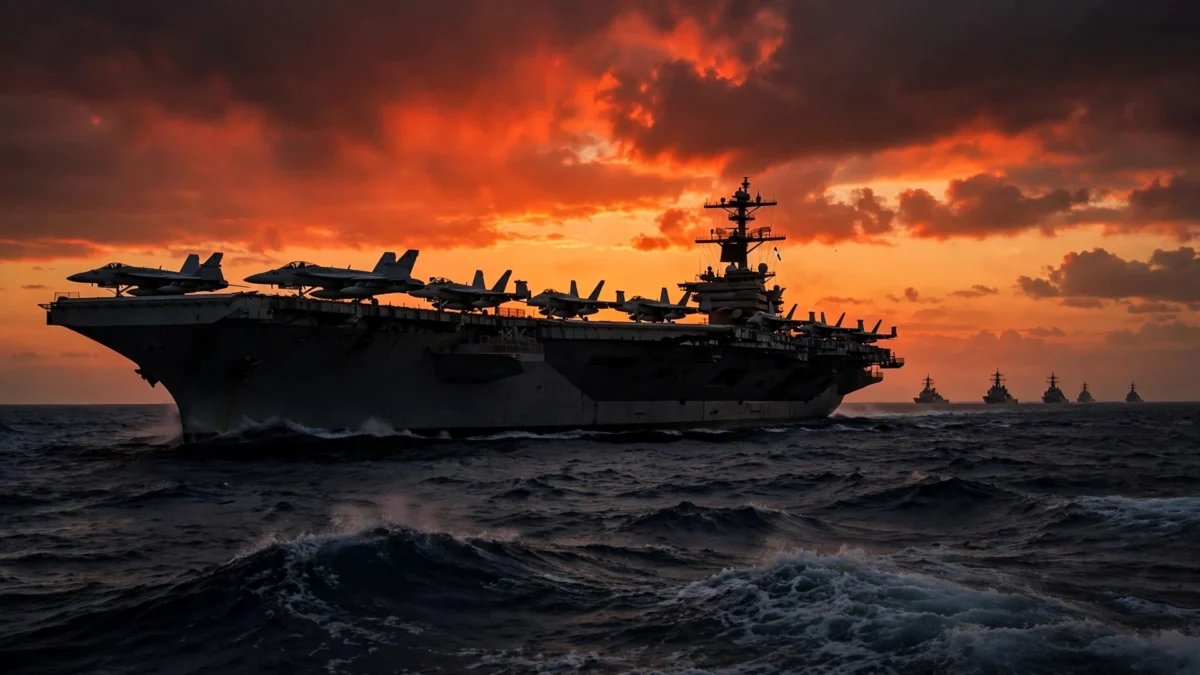
The reports arrive amid a visible military buildup. The Pentagon is moving a third aircraft carrier strike group, built around the USS Theodore Roosevelt, along with an amphibious force carrying more than 2,000 Marines, toward the Middle East, according to Political.org’s reporting on the deployment. Officials say total reinforcements could reach 9,000 to 10,000 additional sailors and Marines in the region by the end of November. That would place three U.S. aircraft carriers and two amphibious landing groups near Iran simultaneously, alongside the USS George H.W. Bush and USS George Washington already on station — the largest concentration of American naval airpower assembled against Iran since the war began.
The buildup has coincided with a diplomatic impasse. According to Axios’s reporting, Trump has spoken with Israeli Prime Minister Benjamin Netanyahu twice in recent days, and last Friday Trump’s national security team held a multi-hour meeting at Camp David where the possibility of resuming major combat operations in Iran was among the subjects discussed. Secretary of State Marco Rubio said after the meeting that discussions centered on “long-term” foreign policy planning.
On the negotiating track, progress appears stalled. Qatari mediators are still awaiting an Iranian response to a U.S. counterproposal that reportedly includes demands for concessions on Iran’s nuclear program, according to Benzinga’s account of the Axios reporting.
Financial markets reacted quickly to the news. West Texas Intermediate crude futures surged more than 4 percent to around $92.25 a barrel on Thursday morning, while the Dow Jones Industrial Average, the S&P 500 and the tech-heavy Nasdaq all moved lower, according to Investors Business Daily’s live market coverage. The 10-year Treasury yield held roughly flat at 5.28 percent.
The escalation in rhetoric and planning follows a pattern of increasingly direct warnings from Trump in recent weeks that the United States could launch another major assault if Tehran does not agree to Washington’s demands. In an Axios interview published on September 17, Trump said he was approaching a “big decision” over whether to “annihilate” the Iranian regime or pursue another course. During his September 22 address to the United Nations General Assembly, he warned that Iran would face devastating consequences if it refused to abandon efforts that Washington said could lead to a nuclear weapon. And in a Time magazine interview published October 1, Trump said expanded U.S. bombing of Iran after the November midterms was “possible,” while adding that the United States had spent months rebuilding its weapons stockpiles.
At the same time, Trump has repeatedly predicted that the war could end before or immediately after the election. On October 1, he said Iran was “ready to fold up” and predicted that the United States would win the war “right after the election,” adding “maybe before the election,” according to CBS News.
The conflict, now in its eighth month, began in February 2026 and has moved through repeated cycles of escalation and fragile truces. An April ceasefire tied to reopening the Strait of Hormuz was later declared over by Trump amid continued fighting. Iran rejected a proposed seven-day ceasefire and has resisted U.S. demands on its nuclear program and the Strait of Hormuz, the critical waterway through which roughly a fifth of the world’s oil flows. Washington, in turn, has rejected a proposal from Tehran to reopen the strait in exchange for lifting the U.S. naval blockade, a standoff that has kept oil prices elevated well above pre-war levels, according to data from the energy intelligence firm Kpler.
Iranian Foreign Ministry spokesman Esmaeil Baqaei wrote on X this week that U.S. actions violate the temporary Strait of Hormuz transit arrangement agreed on June 17, saying the agreement emphasized Iran’s authority over arrangements for ships transiting the strait. Trump, however, has said he no longer wants to deal with Iran and that, as far as he is concerned, the ceasefire is over.
The political backdrop is adding pressure. A Reuters/Ipsos poll released Monday showed Trump’s approval rating at a record low of 32 percent, unchanged from a September poll that marked the lowest rating of his political career, according to IANS. Cost of living is the top issue on American voters’ minds as they decide how to vote next month, with high gasoline and diesel prices directly tied to the Iran standoff and its effect on global crude markets.
Analysis: Why It Matters
Trump’s Wednesday statement is the sharpest public signal yet that the diplomatic track with Iran is effectively dead from Washington’s perspective. A president telling a rally crowd he does not want a deal — while in the same breath saying his envoy is doing “very well” — is not a policy detail; it is a public concession that the two tracks have diverged. The message to Tehran is plain: negotiations may continue as theatre, but the real action has moved to the Pentagon’s planning rooms.
The more consequential development is not the quote but the machinery behind it. There is a meaningful difference between a president musing about strikes and the Pentagon instructing Central Command to complete preparations for major combat operations. The first is rhetoric; the second is logistics — targeting packages, munitions pre-positioning, carrier movements, force protection for the roughly 50,000 American troops stationed in the region, whom officials involved in the discussions have warned could face Iranian retaliation, according to The Atlantic’s reporting. When a military issues completion orders to a combatant command, it is buying optionality at speed. That is what makes this week’s reporting different from Trump’s earlier warnings.
Timing is the third dimension, and it is the one that should draw the most scrutiny. U.S. and Israeli officials themselves told Axios that the timing and scale of any strikes could shape the outcome of the November 3 midterms. Trump has told aides that strikes are “likely” after the elections, predicted the war will end right after the vote, and simultaneously discussed strikes before it. The contradiction is itself instructive: an escalation powerful enough to spike oil prices further could punish the party in power at the ballot box — cost of living is the top issue for voters — while a dramatic military success could swing the other way. The Atlantic’s reporting that officials warned internally that another strike could push oil prices higher suggests the White House is aware of the gamble. Markets already rendered their first verdict on Thursday morning: crude up, stocks down.
The fourth dimension is the coalition. Axios’s reporting that a renewed campaign would most likely be a joint U.S.-Israeli operation, with strikes aimed at Iranian energy, infrastructure and nuclear sites, describes something closer to a war of economic and technological decapitation than the limited strikes of earlier phases. Three carrier strike groups and two amphibious landing groups is not a posture for a one-night bombing run; it is the footprint of a campaign. Netanyahu’s two calls with Trump in recent days, the Camp David meeting, and Israel’s own election on October 27 all point to a coordinated calendar.
What to watch next: first, whether Witkoff’s channel produces anything before the elections — a last-minute Iranian concession on the nuclear file would give both sides an off-ramp. Second, whether CENTCOM’s preparations become visible through satellite imagery or additional force movements, which adversaries and analysts alike will be watching. Third, whether Tehran, which assumes a strike is coming, acts first — either in the Strait of Hormuz, where it retains leverage, or through allied forces in the region, a scenario that would collapse the distinction between “preparation” and “war” before any American order is given.
Sources
JFeed: Pentagon Orders CENTCOM to Prepare for Iran Combat
Newsmax: Pentagon Prepares for Possible Iran Strikes as Trump Weighs Action
Benzinga via TradingView: Iran Combat Operations Could Restart as Pentagon Reportedly Readies Strikes
Political.org: Trump Says He’s ‘Not Keen’ on Iran Deal as U.S. Reportedly Preps ‘Massive Bombing’ Campaign
Investors Business Daily: Stock Market Today — Trump, Oil Prices, Nasdaq

About the Author — Abdul Mannan
Related Articles

Henri Kagan and Kenso Soai Win 2026 Nobel Prize in Chemistry for Solving the Century-Old Mystery of Mirror Molecules
The 2026 Nobel Prize in Chemistry goes to Henri Kagan and Kenso Soai for cracking the century-old puzzle…

Vance Says Iran Must Make ‘Meaningful’ Enrichment Cut to End Seven-Month War With the US
Vice President JD Vance has set out Washington's core condition for ending the seven-month US-Iran war: a concrete…

WHO Presses Russia for Answers on Siberian Lab Worker’s Death as US Sends Formal Information Request
The World Health Organization says it still does not know what killed a 28-year-old laboratory worker in Siberia,…