The Two Guns of Bend: When America Armed Both the Killer and the Hero

Tell me, what does a five-year-old know of hatred? What has a child of eight done to deserve a bullet? And what prayer can a teacher whisper at one o’clock on an ordinary Thursday afternoon, when the locked door of her classroom shatters and the world walks in wearing a sixteen-year-old boy with his mother’s shotgun?
Bend, Oregon, will be asking itself these questions for a long time. On Thursday, October 15, at 12:59 in the afternoon — lunch hour, sunlight, the most ordinary hour of the most ordinary day — a 16-year-old boy walked up to Silver Rail Elementary School carrying a long gun. He shot his way through the locked doors. Inside, he killed three children — aged five, eight, and eleven — and a teacher. He left a seven-year-old child and a 54-year-old teacher critically wounded. And then, before the police had even arrived, he was dead himself, shot by a carpenter who had been driving home for his lunch break.
The father of the five-year-old named his son publicly on Friday: Rhoam Summer. Five years old. Say his name once, and the statistics fall away, and you are left with the one fact that matters — a small boy went to school on Thursday and did not come home.
America now has two funerals to attend, and one very uncomfortable question to answer. Because here is the thing nobody wants to say out loud: the boy who did the killing and the man who stopped the killing had one thing in common. They were both armed. Bend, Oregon, is the first American school shooting in which the hero’s gun and the killer’s gun are part of the same sentence — and the same system.
The Boy With His Mother’s Shotgun
We know the shape of the tragedy now, because law enforcement sources have spoken and reporters have pieced it together. The shooter, a 16-year-old Bend resident identified by senior law enforcement officials to NBC News as John J. Griffin, arrived at the school around one in the afternoon with a pump-action shotgun — a 12-gauge Maverick 88, according to the New York Post. A law enforcement official told The Associated Press the weapon had been purchased by the boy’s mother.
Pause on that sentence. The gun was purchased by his mother. Not stolen from a stranger, not bought in a dark alley — purchased. The weapon that killed three small children was brought into that boy’s life by the woman who gave him life. I do not write this to condemn her; she will carry a weight no sentence of any court can add to. I write it because it tells you something essential about the country where this happened: in America, a shotgun can travel from a mother’s purchase to a classroom floor as easily as a lunchbox.
The Post reports that the boy threw the shotgun over the school’s fence and climbed over himself. At the front door he was confronted — blocked — by two bystanders, one of them a father with two little girls at the school who had noticed the breach while driving by on his way home for lunch. The boy opened fire on the man’s truck, shattering its rear window, then ran around to the back of the building, blew off the lock of the back door — a lock designed, cruelly enough, to prevent exactly this — and walked straight to his former special-needs classroom. That was his target. He opened fire there.
The first 911 call came at 12:59 p.m., from a person in a vehicle outside the school who reported being shot at. Officers arrived at 1:02. Three minutes. In any city on Earth, that is a fast response. By then, the suspect was already down. The police never got their confrontation. The state, with all its sirens and its training, arrived at a scene where the dying had already been done — both the children’s and the shooter’s.
The Father With His Lunch Break
And now the second gun. The man in the red Toyota Tacoma, the father who spotted the boy from his truck, is Kaylub Giamanco — 36 years old, a local carpenter, the father of two daughters who attend Silver Rail Elementary. He had a concealed-weapon permit. He was, by his family’s account, simply driving home for his lunch break when he heard the gunshots.
He followed the teenager into the school and shot him dead. His family, in a statement released to CBS News, said he is not seeking recognition — only that he wishes to express gratitude to the first responders, school personnel, and the community for the outpouring of love. His brother told NBC News that he had heard the shots before he even saw the suspect enter.
President Donald Trump praised Giamanco on Friday, calling him a “great hero.” “He took care of business, and thank God we had him, otherwise it would have been much worse,” the President told reporters. “Thank goodness for a man that had a gun and knew how to use it.”
And there, in that sentence from the President of the United States, is the whole American story told in one breath: thank goodness for a man that had a gun. Not thank goodness for the locked doors — they were shot through. Not thank goodness for the police — they arrived at 1:02, to a corpse. Thank goodness for a man that had a gun and knew how to use it. The rescue, like the attack, was privately armed. The demon came with a shotgun his mother bought; the angel came with a pistol his state licensed. Two guns, one parking lot, four dead children and teachers — one of them five years old — between them.
I do not mock Kaylub Giamanco. God knows, he did what had to be done, and did it when nobody else could. A father protecting children — including his own two daughters, who could have been in that hallway — deserves the honour being heaped on him. But hear the question underneath the honour: what kind of country has arranged its life so that the only thing standing between a five-year-old and a shotgun is a carpenter’s lunch break?
Columbine Is the Mirror; Sandy Hook Is the Verdict
You who read me know my method: I hold the present up to the mirror of the past, and I ask you to look. Look, then, at the gallery America has hung on its own wall.
Columbine, April 20, 1999 — twelve students and a teacher killed, and a nation swore it would never happen again. Sandy Hook, December 14, 2012 — twenty first-graders, six and seven years old, and six adults murdered in Newtown, Connecticut — and a President wept on television, and the nation swore it would never happen again. Parkland, February 14, 2018 — seventeen dead. Uvalde, May 24, 2022 — nineteen children and two teachers, while armed officers waited in the school hallway and parents begged them to move, and the nation swore — you know the sentence by now.
Bend is October 15, 2026. Do the arithmetic of grief with me: twenty-seven years from Columbine to Bend. In that time, according to the Washington Post’s database, more than 278,000 American students have experienced gun violence at their schools. Everytown for Gun Safety counts at least 100 incidents of gunfire on school grounds in 2026 alone, with 34 people dead — and CNN counts Bend as the 36th shooting on a K-12 school property this year. The Gun Violence Archive counts 369 mass shootings in America in 2026. The school year is not even over.
Sandy Hook was supposed to be the hinge of history. That was the article of faith. If the murder of twenty first-graders could not move the republic, nothing could — and nothing did. So understand what Bend is: not an aberration, not a shock, not a wake-up call. A wake-up call is something you hear once. America has been hearing it for twenty-seven years and has learned to sleep through the alarm.
Here is the mirror, and it is a terrible one. In Uvalde, the armed men with badges waited. In Bend, the armed man without a badge acted. The debate that will now consume America — and it is already consuming it, 25,000 likes and a thousand furious comments on a single social-media post — is not really about whether the carpenter was right. It is about whether a society can call itself civilised when it has outsourced both its violence and its rescue to the private gun owner, and then holds a candlelight vigil and calls it a response.
The Liturgy of Grief
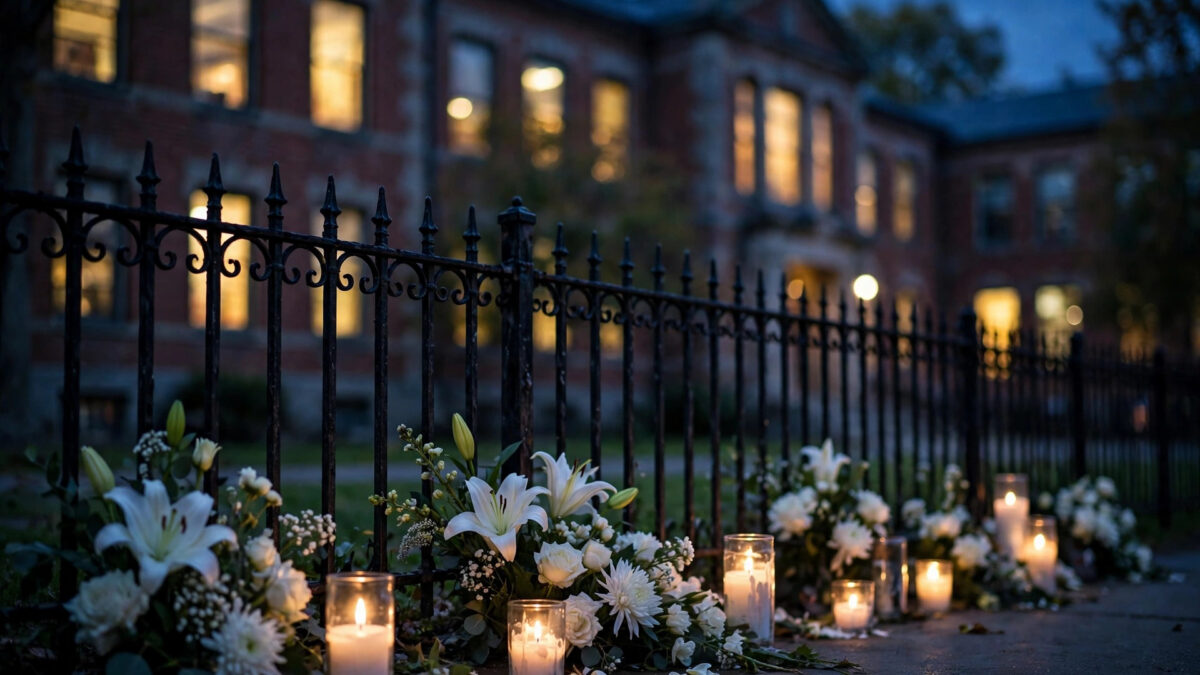
On Thursday evening, hundreds of people gathered at Drake Park in Bend for a candlelight vigil. Children held candles. Flowers piled up at the school fence. The superintendent of the Bend-La Pine school district, Steve Cook, stood before cameras and said: “We are heartbroken. We are horrified. This is the kind of thing you hear about in other places and pray that it never happens here. And it has happened here.”
I do not doubt a word of his grief. But listen to the liturgy, because America performs it with priestly precision every time: the vigil, the flowers, the lowered voices on television, the statements from the governor and the FBI director, the “thoughts and prayers,” the praise for the hero, the promise of an investigation, the argument about the guns that burns hot for ten days and then cools into nothing. Then the next school, the next town, the next superintendent saying he never thought it could happen here.
It always happens “here” eventually, because “here” is everywhere. There is no town in America that is not a potential Bend. The 36th school shooting of the year did not happen in a war zone or a failed state. It happened in Bend, Oregon — a mountain town of craft breweries and river trails, the kind of place people move to precisely because it is safe. Safety, in America, is a rumour the next headline disproves.
And notice what the liturgy never includes: the reckoning. The Second Amendment was written in 1791, when a “well regulated militia” carried muskets that took a minute to reload. It now sanctifies a country where a sixteen-year-old can carry a pump-action shotgun to his old classroom. Every other wealthy nation on Earth looked at America’s ritual and chose differently — and their children go to school without active-shooter drills. America looked at the same evidence and chose the vigil. The vigil is beautiful. The vigil changes nothing. That is why it is a liturgy and not a policy.
A Civilisation That Armed Its Own Rescue
Now let me tell you the fresh angle — the thing nobody else is writing, because everyone else is too busy fighting the old war.
The old war is the gun debate: more guns or fewer guns, the Second Amendment or the children’s lives, the left’s laws or the right’s liberty. You have heard it ten thousand times. It is the argument America has instead of a solution.
But Bend is not the old war. Bend is something new and darker. Bend is the moment the two sides of the old war merged into a single scene. The killer’s gun and the hero’s gun fired in the same hallway, minutes apart, and the system that put both guns there is the same system. America did not merely fail to disarm the sixteen-year-old; it succeeded in arming the thirty-six-year-old. And then it stood back and called the result freedom.
Think about what that means. The state has quietly confessed that it cannot protect your five-year-old. The locked doors were shot through. The police arrived in three minutes — three minutes! — and it was already over. So the protection of children has been privatised: it now depends on whether a carpenter happens to be driving home for lunch, happens to have a concealed permit, happens to have the courage to walk into a school behind a boy with a shotgun. Thank goodness for a man that had a gun, said the President — and he was right, and that is the tragedy. The rescue worked. The system failed. Both statements are true at once, and a serious country would sit with the contradiction until it hurt enough to act.
Instead, America will do what it always does: it will turn Kaylub Giamanco into a hero — deservedly — and it will turn Rhoam Summer into a memory — inevitably — and it will change nothing, because changing something would require admitting that the vigil is not a response. A response is what you do before the children die.
The Verdict
I am a father. You may be a father, or a mother, or someone who loves a child. So let me speak to you directly, without the armour of analysis.
A sixteen-year-old boy threw a shotgun over a school fence on Thursday. Why? We do not know yet — the investigation is young, and his motives are still unknown. But I know this: a boy who does such a thing is himself a casualty before he is a criminal. Somewhere between his mother’s purchase of that shotgun and his decision to climb that fence, a child was lost too. America will bury him without a vigil, and that, too, is part of the sickness — the country that armed him will not mourn him, because mourning him would mean asking what made him.
And the five-year-old? Rhoam Summer had a name, a face, parents who posted his photograph with pride. He was five. He did not know what the Second Amendment was. He did not know what a pump-action shotgun was. He knew his classroom, his teacher, his friends. That is the entire biography hatred needs to destroy — a small life, fully lived, ended at one in the afternoon because the adults of the most powerful nation in human history could not agree that children should be safe at school.
History will not remember October 15, 2026, as the day a hero stopped a shooter. History will remember it as the day America proved, again, that it would rather arm the rescue than prevent the need for one. Columbine was the warning. Sandy Hook was the verdict. Bend is the epitaph — written not in stone but in candle wax at Drake Park, melting by morning.
Unless. Unless this time the mirror is held long enough. Unless the two guns of Bend — the killer’s and the hero’s, fired in the same hallway — finally force the question America has dodged for twenty-seven years: what does it profit a nation to gain the right to bear arms, and lose its children in the bearing?
Answer that, and you will have answered everything. Fail to answer it, and the next superintendent is already rehearsing his sentence: we never thought it could happen here.
Sources & References
- NPR — “3 children, teacher killed in shooting at Oregon elementary school” (October 16, 2026)
- USA Today — “‘Thank God we had him’: Hero stops active shooter at elementary school” (October 16, 2026)
- Bazaar Daily News America — “Live Updates: Five Dead in Shooting at Bend, Oregon Elementary School” (October 16, 2026; reporting Associated Press and NBC News details)
- New York Post — “The extreme measures Oregon shooter took to enter the school — and why he targeted special-ed room” (October 16, 2026)
- Al Jazeera (via Tribecans) — “Three children, one teacher killed in Oregon school shooting” (October 16, 2026; Gun Violence Archive and Everytown statistics)
- World Population Review — “School Shootings by Country 2026” (historical data: Columbine, Sandy Hook, Parkland, Uvalde)

About the Author — Abdul Mannan
Related Articles
They Fired the General Who Counted the Missiles: America’s Empty Quiver in the Iran War
In December 2025, Army Chief of Staff Gen. Randy George warned the Pentagon that America's missile-defense arsenal would…
The Emperor of the Sky: When One Man Holds a Nation’s War in His Hand
When SpaceX throttled Ukraine's Starshield access at 100 mph during Russian missile strikes, one private man's network dimmed…
A Crown on the Pavement: What a Fallen Royal in London Teaches About Power
An Abu Dhabi royal, found slumped unconscious on a London street while a barefoot three-year-old played near traffic,…