Navi Pillay, 85-Year-Old Anti-Apartheid Jurist, Wins 2026 Nobel Peace Prize as Trump Misses Out Again

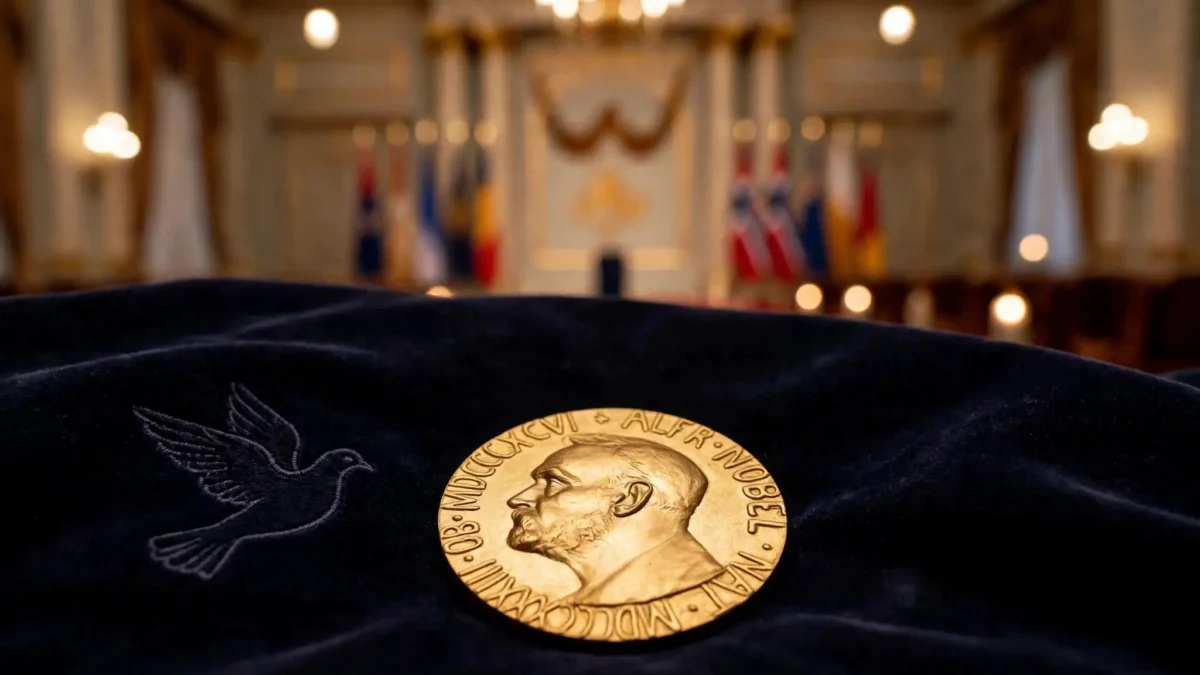
The Norwegian Nobel Committee awarded the 2026 Nobel Peace Prize on Friday to Navanethem “Navi” Pillay, an 85-year-old South African jurist, honouring a six-decade career that carried her from defending anti-apartheid activists in apartheid-era Durban to presiding over the international tribunal that first recognised rape as an act of genocide.
The announcement, made in Oslo by committee chair Jørgen Watne Frydnes, praised Pillay as a person who, in the committee’s words, “with exceptional courage and integrity has led the way towards a more comprehensive global legal order”. According to the committee, this year’s laureate “has been instrumental in ensuring that war crimes, crimes against humanity and genocide are prosecuted”.
Frydnes told reporters that the committee had struggled to reach the laureate before the announcement. “Unfortunately, we have not been able to reach Navi Pillay,” he said. “My message to her would be: if you see a Norwegian number calling, please pick up. I would love to talk to you very soon.”
Pillay was chosen from 287 nominations — individuals and organisations combined — for the prize, which carries an award of 12 million Swedish kronor, roughly $1.2 million, according to the committee. This year’s award marks the 125th anniversary of the Nobel Peace Prize, first conferred in 1901.
The South African presidency and human rights organisations across the world hailed the decision within minutes of the announcement. Agnes Callamard, the head of Amnesty International, posted a video showing Pillay being applauded as she learned of the award. In her first reaction, captured on the video, Pillay laughed: “If you clap a little bit more, I might share this prize with Trump.” She added that when the committee chair finally reached her, her response was disbelief: “I said ‘it must be a joke’. Being a lawyer and a judge, I still want to ratify this.”
A life built in defiance of apartheid
Born in Durban in 1941 to a family of Tamil descent, Navanethem Pillay grew up in a poor district of the city under the machinery of apartheid, a system designed to remind her, at every turn, of her supposed inferiority. She refused the instruction. After studying law — including a master’s degree and doctorate at Harvard, according to biographical accounts — she became, in 1967, the first woman to open her own law practice in Natal Province, then in 1973 won a landmark ruling giving political prisoners on Robben Island, including Nelson Mandela, the right of access to legal representation.
The Robben Island case was not a symbolic gesture. Through it, Pillay exposed the regime’s state-sponsored torture, illegal interrogation tactics and the harsh conditions of solitary confinement endured by the prisoners of the apartheid state. It made her, in her twenties, one of the most formidable courtroom adversaries the white-minority government faced.
After the fall of apartheid, she helped shape the equality clause of South Africa’s new constitution — the provision that prohibits discrimination on grounds of race, religion and sexual orientation — and Mandela, by then president, appointed her as South Africa’s first non-white woman judge on the High Court.
From Rwanda to the world’s highest courts
Mandela then nominated Pillay to the newly created International Criminal Tribunal for Rwanda, where she served eight years, the last four as its president. Her defining legacy there was written in the tribunal’s very first case: a ruling that rape could constitute an act of genocide, and a definition of rape in international law that transformed how gender-based violence in war is understood and prosecuted around the world. According to her biographers, she took the post to provide, as she put it, “justice for Rwandans”.
In 2003 she was elected a judge of the International Criminal Court in The Hague, serving until 2008, when the UN General Assembly approved her appointment as United Nations High Commissioner for Human Rights. She held that post from 2008 to 2014, travelling the world and speaking out, in the words of observers, with the same judicial impartiality she had brought to every earlier role. She openly condemned Arab governments for cracking down on popular uprisings, including in Libya and Syria, and pressed states everywhere on the treatment of detainees and victims of torture.
Her most recent high-profile work was as chair of the UN’s Independent International Commission of Inquiry on the Occupied Palestinian Territory, whose findings — that Israel committed genocide in Gaza in its war against Hamas following the October 7, 2023 attacks — made her one of the most controversial figures in international justice. She currently sits ad hoc on the International Court of Justice in the case in which Myanmar is accused of crimes against the Rohingya minority, according to The Times.
Even into her eighties, Pillay has refused the conventional pace of retirement. Biographical profiles note that she now also heads the International Commission Against the Death Penalty, and that well past the age when most jurists lay down their pens, she continues to take on the fights others consider finished. “Why would you need courage to speak the truth?” she said in her first reaction to the prize, as reported by The Times. “I just turned 85 last month. I can’t stop my work.”
Trump’s coveted prize slips away again
The award also carries an unavoidable political dimension, because it definitively denies, for a second consecutive year, the prize that US President Donald Trump has openly and repeatedly declared he deserves.
Trump had mounted a last-minute campaign for the honour this week. Speaking in the Oval Office on October 7, two days before the announcement, he argued that he deserved the prize for settling or preventing conflicts around the world, insisting, “I’m not bragging. I’m just telling you the facts. No president probably has settled any wars. I settled eight wars, and big ones.” According to USA Today, Trump acknowledged the committee’s reluctance but warned that withholding the prize “would be a great discredit to them”.
His claimed record included the nominal Israel-Hamas ceasefire that has held since October 2025 — brokered in part through American pressure — as well as the US military intervention in February intended to prevent Iran from obtaining a nuclear weapon, and US-led negotiations to end Russia’s war in Ukraine. GOP Representative Anna Paulina Luna of Florida is among the Trump allies who have said they formally nominated him, according to USA Today.
Last year the prize went instead to Venezuelan opposition leader María Corina Machado, honoured for her struggle for democratic rights in Venezuela. In an extraordinary coda, Machado presented Trump with her physical Nobel medal during a White House meeting in January 2026, describing the gesture as recognition of his support for Venezuelan freedom after the US military operation that captured and ousted Nicolás Maduro. The Norwegian Nobel Institute responded that the prize is non-transferable: “Once a Nobel Prize is announced, it cannot be revoked, shared, or transferred to others,” it said in a statement.
The 2026 announcement was made months after that operation, in the context of a presidency that has since launched wars against Venezuela’s ousted leadership and against Iran, all while the president continued to insist his peacemaking credentials were unmatched. The committee’s citation — a tribute to the prosecution of war crimes and the rule of law — lands, intentionally or not, as the antithesis of that narrative.
A committee sends a message
It is worth noting what the committee chose to say about why it picked this year, and this laureate, for this prize. “At a time when the number of wars and conflicts is rising, and when judges and institutions of international law are under political attack, the Nobel Committee wishes to issue a reminder that the ability to resolve conflicts without force or violence is dependent on the international rule of law,” the committee said in its news release, as reported by NPR.
That line is doing heavy lifting. International courts and their judges have spent the year under extraordinary political pressure — sanctions threats, funding freezes, accusations of bias from multiple directions. By awarding the prize to the woman who embodied the post-war legal order at its most ambitious — from Rwanda’s tribunals to the ICC to the occupied territories inquiry — the committee was not simply honouring a distinguished career. It was issuing a declaration: that the institutions built to make war a crime, rather than a tool of statecraft, are worth defending precisely now.
Whether that message lands where the committee hopes is another matter. The prize will be presented at a ceremony in Oslo on December 10, the anniversary of Alfred Nobel’s death, by King Harald V’s representative in keeping with tradition. Pillay, who could not be reached before the announcement, will presumably accept in person — if her 85 years and her stated refusal to stop working are any indication, she will have plenty to say.
Analysis: Why It Matters
Begin with what this prize is not: it is not, and was never going to be, Donald Trump’s. The feverish week of campaigning — the “eight wars” arithmetic, the Oval Office audition, the warning that snubbing him would discredit the committee — was theatre built on a misunderstanding of what the Norwegian Nobel Committee does. It does not award power, or proximity to power, or the ability to end a war by starting one. It awards the idea that peace is a system, not an event — a system of laws, courts, precedents and institutions that outlive any single strongman. That is why the committee reached back to a woman whose formative victory was won in 1973, in an apartheid courtroom, and whose most famous ruling redefined genocide for all time.
The contrast the committee drew is almost architectural. Trump’s peacemaking, as he describes it, is personal, transactional and spectacular: deals struck, tariffs deployed, hostages returned, and the occasional capital city occupied. Pillay’s peace work is institutional, procedural and grindingly slow: definitions hammered out in courtrooms, rapists’ victims given standing in international law, commissions of inquiry that produce reports nobody in power wants to read. The committee has chosen the slow thing over the spectacular thing, and said so, in the middle of a year when the spectacular thing holds the White House.
There is a second, quieter message embedded in the choice. Pillay’s most recent commission work — the Gaza inquiry — made her enemies in precisely the capitals that are loudest in their support for the international order. The committee did not flinch from that. By honouring her whole body of work, it refused the premise that accountability for war crimes is legitimate only when the accused are geopolitical adversaries. That is the hardest test of the rule-of-law idea, and the committee applied it to itself.
And there is a third message, directed at the jurists and institutions of international law who are, as the committee put it, “under political attack”. The ICC has faced sanctions threats, its prosecutors have faced personal pressure, and the vocabulary of “lawfare” has been deployed against every adverse ruling. The Nobel Committee cannot protect a court with a medal. But it can do the next best thing: declare, on the most watched prize stage in the world, that these institutions are civilisation’s achievement, not its obstacle. That declaration now travels with Pillay’s name.
What to watch next is partly ceremonial and partly political. The December 10 ceremony in Oslo will give Pillay, finally, the microphone she could not be reached for on Friday — and few laureates in memory have used that microphone more pointedly than this one is likely to. In Washington, watch how the White House responds to a second consecutive denial, and whether the “politics over peace” framing it deployed after the 2025 snub returns. In The Hague, watch whether the prize lends any protection to the courts the committee praised, or whether the attacks intensify precisely because the committee picked this fight. And in Oslo, watch the Norwegian Nobel Institute, which last year had to publicly explain that medals cannot be transferred — a clarification that may need no repeating, but which, given the cast of characters, probably will.
Sources
- Wall Street Journal — Nobel Peace Prize Goes to Navi Pillay, Mandela Lawyer Who Led Human Rights at U.N.
- USA Today — Donald Trump passed over for Nobel Peace Prize he’s long coveted
- USA Today — Nobel Peace Prize awarded to South African lawyer Navi Pillay
- The Times — South African lawyer Navi Pillay wins 2026 Nobel peace prize
- NPR — South African Human Rights lawyer Navi Pillay wins Nobel Peace Prize
- India Weekly/AFP — At 81, South Africa’s fearless rights defender Navi Pillay fights on (biographical profile)

About the Author — Abdul Mannan
Related Articles

Malaysia Closes Schools Across Four States and Its Two Capitals as Indonesian Wildfire Haze Smothers Southeast Asia
Schools across Johor, Malacca, Negeri Sembilan and Selangor, plus Kuala Lumpur and Putrajaya, were ordered shut on Friday…
Witkoff and Kushner to Present New Ukraine Peace Plan in Miami as Kremlin Agrees War Is a “Stalemate”
Trump's envoys Steve Witkoff and Jared Kushner will meet a Ukrainian delegation in Miami on Friday to discuss…

Trump Says He No Longer Wants an Iran Deal as Pentagon Readies Possible New Strikes
President Trump said he no longer wants an Iran deal as the Pentagon readies possible new strikes, with…