Malaysia Closes Schools Across Four States and Its Two Capitals as Indonesian Wildfire Haze Smothers Southeast Asia

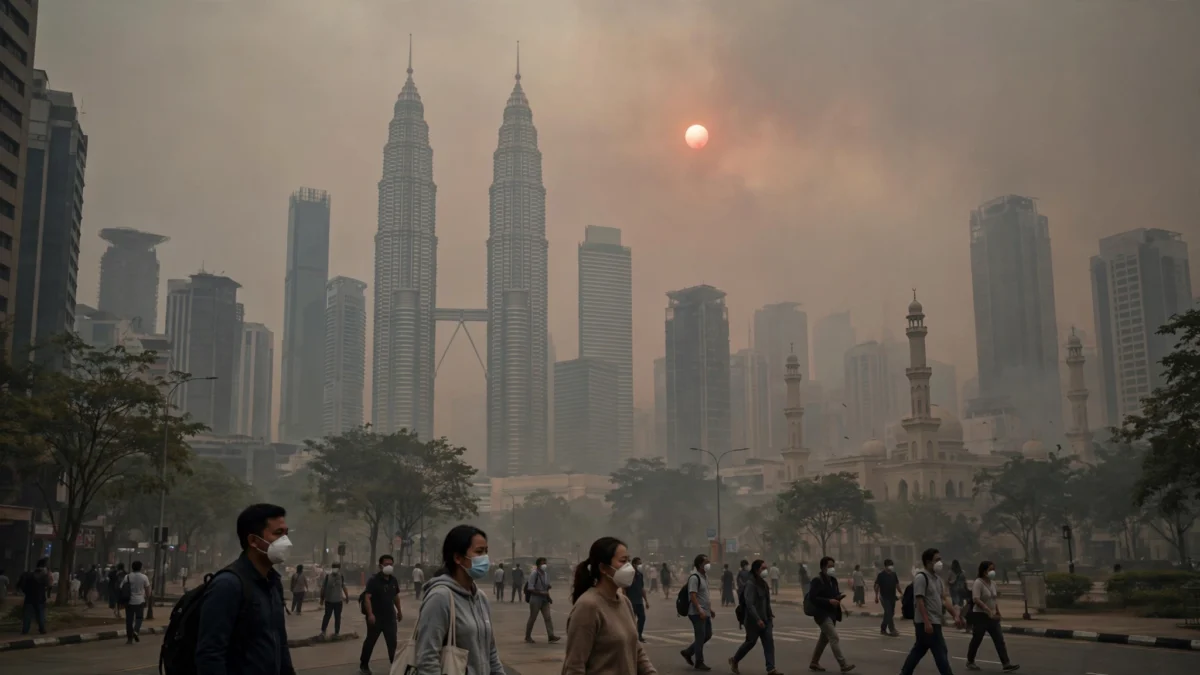
Schools across four Malaysian states and the country’s two capitals stayed closed on Friday as a thick blanket of toxic haze drifting from Indonesia’s raging wildfires pushed air pollution deep into unhealthy territory, in what is shaping up to be Southeast Asia’s worst transboundary smog crisis in more than a decade.
Education Minister Fadhlina Sidek announced late on Thursday that schools in Johor, Malacca, Negeri Sembilan and Selangor — along with the national capital Kuala Lumpur and the administrative capital Putrajaya — would be shut on Friday. The Rompin district of Pahang state was included in the closure order as well, according to Reuters, which reported the announcement on Friday morning.
The closures were ordered after smoky haze caused by forest and land fires burning across several Indonesian provinces sent Malaysia’s Air Pollutant Index (API) into unhealthy ranges. In a Facebook post late on Thursday announcing the decision, Fadhlina Sidek said: “I have asked all state education departments and district education offices to continue to monitor the haze situation and take immediate action if the situation requires it,” according to Reuters.
On Friday morning, 37 areas across Malaysia recorded unhealthy API readings, according to government data cited by Reuters. Malaysia’s index classifies air quality as unhealthy between 101 and 200, very unhealthy between 201 and 300, and hazardous above 300.
The worst-hit zone has been the Batu Pahat district of Johor state, about 140 kilometres northwest of Singapore, where around 200 schools, kindergartens and nurseries were ordered to close on Wednesday because of the haze, according to local media reports cited by the Singapore outlet Tabla. Pollution levels there kept climbing: an API reading of 203 was recorded in Batu Pahat, placing the area firmly in the “very unhealthy” category, and the Johor government subsequently announced that all schools across the state would close for two days starting from October 8 as a precaution to protect students, according to the fact.net.in news report. Other parts of Johor — including Segamat, Pasir Gudang, Tangkak, Kluang, Larkin, Kota Tinggi and Pengerang — also recorded unhealthy readings.
Across the border in Singapore, conditions deteriorated sharply. The city-state’s air pollution worsened to the highest in the world as haze from the Indonesian wildfires blanketed the region, with air quality in the “very unhealthy” range late on Wednesday, according to data from IQAir cited by Tabla. Nearby Kuala Lumpur, which had earlier held the top spot, ranked as the second-most polluted city in the world. Singapore’s National Environment Agency (NEA) data pegged the air in all five regions of the city at unhealthy levels, and the agency’s latest outlook warned that dry conditions were forecast for the next few days over most of southern Southeast Asia, keeping the risk of fires and transboundary haze elevated. Singapore had recorded a 24-hour Pollutant Standards Index of 102 to 135 on October 6, already in the unhealthy range, according to travelandtourworld.com.
The timing could hardly be worse for Singapore, which is preparing to host its annual Formula One Grand Prix at the Marina Bay Street Circuit this weekend. A spokesperson for Singapore GP Pte Ltd, which organises the race, said on Tuesday that it would work closely with relevant agencies “to assess the situation before making any collective decisions regarding the event” should the haze cause visibility, public health or operational issues. A Formula One spokesperson said conditions were not at any level of concern. The motorsport’s governing body, the FIA, has said some outdoor entertainment activities could face restrictions if conditions deteriorate further, though the race itself is not currently expected to be affected, according to the fact.net.in report. Organisers have a playbook for this scenario: during the 2019 Singapore Grand Prix, when the city also experienced unhealthy haze, medical assistance was made available and N95 masks were provided to people who needed them.
Behind the regional crisis is Indonesia’s struggle to contain one of its worst wildfire seasons in years. Swathes of Southeast Asia have been clouded in choking smog in recent weeks as the uncontrolled blazes burn on. The fires stem from the long-running use of slash-and-burn agricultural practices, but fire conditions have been badly exacerbated by an intensifying El Nino that is parching the landscape, according to Tabla. The number of fire hotspots last month was the highest since 2015 — the year of the region’s last haze emergency — according to the Forestry Ministry’s fire-monitoring platform SiPongi. Smoke from fires in southern Sumatra and West Kalimantan continues to feed the regional smog, according to travelandtourworld.com, while Reuters reported that Indonesia has struggled to contain forest and land fires across several provinces, producing the thick haze now sitting over Malaysia and Singapore.
The diplomatic pressure is rising alongside the smoke. Johor’s Chief Minister Onn Hafiz Ghazi has urged the Association of Southeast Asian Nations (ASEAN) to take a more active role in tackling the regional haze crisis and called for an emergency meeting, according to the fact.net.in report. But neighbouring countries have few options for legal recourse, experts say. Haze from Indonesian wildfires has blanketed Malaysia and Singapore for more than a month, closing schools and sending respiratory complaints skyrocketing, The Daily Tribunal reported last week. Suggestions that Malaysia and Singapore take Indonesia to the International Court of Justice in The Hague face a basic obstacle, the report noted, quoting Professor Mohd Hazmi Mohd Rusli of Universiti Sains Islam Malaysia: the ICJ generally requires the consent of both states, and Indonesia would be unlikely to willingly accept its jurisdiction on the issue. None of the three countries is a party to the 1979 Convention on Long-range Transboundary Air Pollution, and while all three are parties to the ASEAN Agreement on Transboundary Haze Pollution, the 2002 deal contains no clause on litigation before the ICJ.
Analysis: Why It Matters
The most telling fact in this story is not the pollution readings but the school gates. When a government closes schools across four states and both of its capitals, it is making a public admission: the air is no longer safe for children to breathe. That threshold — and not any index number — is what turns a recurring seasonal nuisance into a national emergency, and it is why this week’s events belong in the same category as the 2015 crisis rather than the routine haze episodes that have come and gone since.
The 2015 parallel is worth taking seriously. SiPongi’s hotspot count for last month was the highest since that year, when a regional haze emergency caused widespread disruption and diplomatic tension across Southeast Asia. A decade of climate summits, regional agreements and corporate zero-burning pledges later, the region is back where it started — because the underlying economics never changed. Slash-and-burn remains the cheapest way to clear land, and an El Nino year makes cheap and catastrophic coincide. Until the cost of lighting a fire exceeds the cost of clearing land any other way, the decade cycle will keep repeating: hotspots, haze, school closures, diplomatic protests, rain.
The legal architecture deserves a second look too. The ASEAN Agreement on Transboundary Haze Pollution was signed in 2002 — nearly a quarter-century ago — and, as the legal analysis cited this week shows, it contains no litigation clause and no compulsion mechanism. The ICJ route requires Indonesian consent that will never come. In practice, the region’s transboundary-pollution regime is a cooperation treaty in a crisis that needs enforcement. That design gap is not an accident of drafting; it reflects the same sovereignty sensitivities that make every ASEAN intervention a negotiation. The Johor chief minister’s call for an emergency ASEAN meeting is therefore politically legible but structurally familiar: regional summits have produced action plans before, and the fires have burned anyway.
There is also a spotlight effect at work. Singapore’s Grand Prix puts one of Asia’s biggest sporting weekends under a smoky sky, with global television cameras on the way. Race organisers have institutional memory of 2019 — masks and medical stations are a known playbook — and the FIA’s careful wording, distinguishing the race itself from “some outdoor entertainment activities,” shows how the contingency thinking works: protect the marquee event, flex everything around it. That is rational event management, but it also illustrates how the haze crisis is experienced in layers — as a health threat for children and outdoor workers, a logistics problem for an F1 weekend, and an abstraction for everyone watching on television.
The most immediate question is meteorological. The NEA’s forecast of continued dry conditions means no natural relief is on the way, and in a transboundary crisis the wind matters as much as the firefighters: a shift in monsoon winds can clear Singapore and Kuala Lumpur in a day, or lock the smog in for weeks. The fires themselves will keep burning until the burning stops making economic sense or the rain arrives — and with an intensifying El Nino, the rain may not arrive soon.
Four things to watch: first, whether Friday’s school closures are extended into next week or widened to more districts, which would signal the authorities expect the crisis to deepen. Second, whether the Johor chief minister’s call for an emergency ASEAN meeting gains traction — and whether Jakarta engages or deflects. Third, the Singapore Grand Prix decisions as conditions evolve through the weekend, which will be the most globally visible test of the crisis. And fourth, the SiPongi hotspot counts and wind forecasts — the two numbers that will decide how long Southeast Asia stays under the smoke.
Sources
- Reuters: “Malaysia closes schools in several states, territories due to haze”
- Tabla: “Haze in Singapore Bad, Neighbouring Malaysia to Shut Schools”
- fact.net.in: “Singapore Chokes on Haze as Indonesian Wildfires Worsen”
- The Daily Tribunal: “Indonesia haze chokes neighbouring countries with little legal recourse”

About the Author — Abdul Mannan
Related Articles

Witkoff and Kushner to Present New Ukraine Peace Plan in Miami as Kremlin Agrees War Is a “Stalemate”
Trump's envoys Steve Witkoff and Jared Kushner will meet a Ukrainian delegation in Miami on Friday to discuss…

Trump Says He No Longer Wants an Iran Deal as Pentagon Readies Possible New Strikes
President Trump said he no longer wants an Iran deal as the Pentagon readies possible new strikes, with…

Henri Kagan and Kenso Soai Win 2026 Nobel Prize in Chemistry for Solving the Century-Old Mystery of Mirror Molecules
The 2026 Nobel Prize in Chemistry goes to Henri Kagan and Kenso Soai for cracking the century-old puzzle…