Witkoff and Kushner to Present New Ukraine Peace Plan in Miami as Kremlin Agrees War Is a “Stalemate”

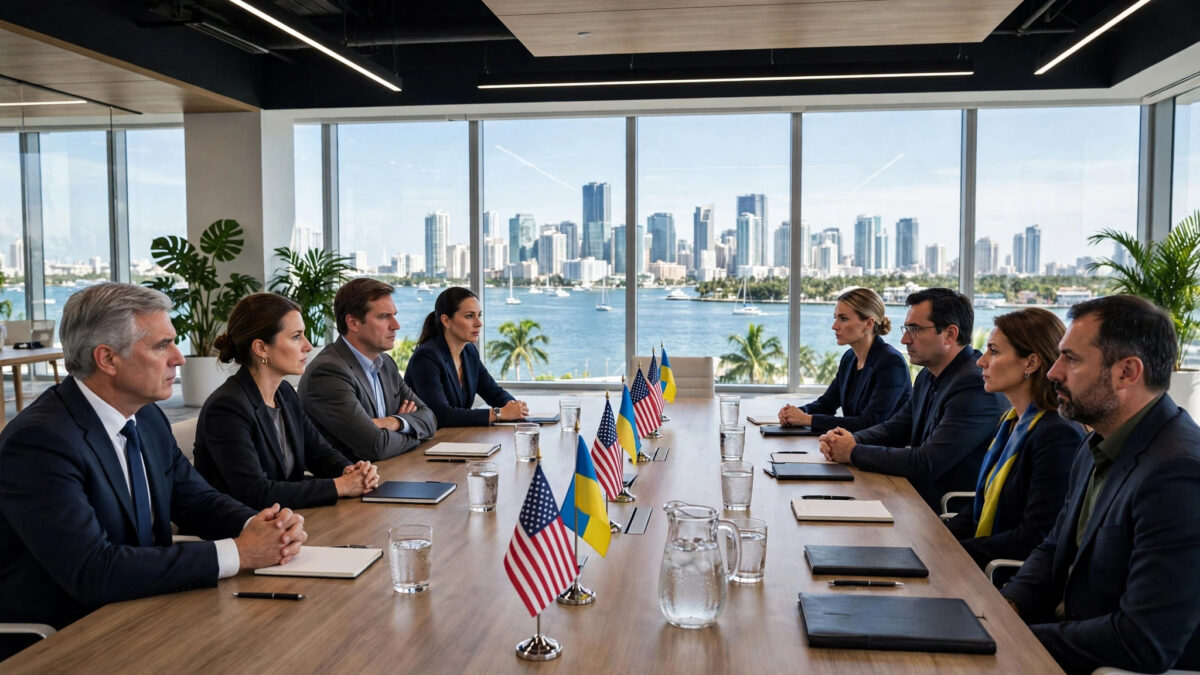
The United States is preparing what may be the most structured diplomatic push of the year to end the war in Ukraine, with President Donald Trump’s envoys Steve Witkoff and Jared Kushner set to meet a Ukrainian delegation in Miami on Friday for two days of talks aimed at producing a unified peace proposal, according to Reuters.
An American source familiar with the plan said on Thursday that the envoys would hold a working session with the Ukrainians to discuss new ideas and proposals that American negotiators began developing with both the Russians and the Ukrainians during their recent visit to the region. Representatives from the White House National Security Council and the US Treasury Department will also take part, and Washington has invited the national security advisers of the United Kingdom, France and Germany, along with officials from NATO and the European Union, to join the discussions.
Ukraine’s delegation is expected to include some of Kyiv’s most senior figures: presidential chief of staff Kyrylo Budanov, Foreign Intelligence chief Rustem Umerov, diplomatic adviser Sergey Kyslytsia and parliamentary negotiator Davyd Arakhamia, according to reporting by Axios, cited by Newsmax.
The agenda for the session is expected to include proposed security guarantees for Ukraine, a postwar prosperity plan and other aspects of the conflict, the US source told Reuters. The Europeans, the source added, had communicated to Washington their frustration with high energy costs and other major financial impacts of the conflict, and warned of a difficult winter ahead if the fighting continues.
The announcement of the Miami talks came on the same day that both Washington and Moscow, for the first time, converged publicly on the same word to describe the state of the war: stalemate.
US Secretary of State Marco Rubio told reporters in Lisbon on Thursday that the conflict was at a dangerous stalemate and warned that further escalation could spill beyond Ukraine’s borders. He cautioned that escalation could become a campaign of sabotage in neighbouring NATO countries and could turn a war between two countries into a much broader and far more dangerous regional conflict, according to the Australian Associated Press, which published the full Reuters dispatch.
Hours later, Kremlin spokesman Dmitry Peskov, speaking on the sidelines of a meeting of leaders of former Soviet states in Turkmenistan, said Russia agreed with that assessment. Russian news agencies quoted Peskov as saying, in response to Rubio’s remarks, that Russia agreed with him. Peskov added that it was up to diplomats to find ways of moving towards peace, telling the agencies that the art of diplomacy involved finding a way out that would allow the sides to move onto a peaceful track.
It was a rare moment of rhetorical agreement between the two capitals, and it arrived less than 24 hours before the scheduled start of the Miami talks. Peskov was careful, however, to add that he saw no immediate prospect for a three-way summit between Russian President Vladimir Putin, Ukrainian President Volodymyr Zelenskiy and President Trump. He restated the Kremlin’s long-held position that Moscow wants an overall solution to the conflict rather than temporary measures such as a limited ceasefire, telling Russian agencies that Russia was not for a fragmented solution but for a comprehensive one that would allow a sustainable settlement for decades.
In Kyiv, Zelenskiy confirmed on Thursday that Ukrainian negotiators would raise the issue of air defences in the talks, in light of near-constant Russian strikes on Ukrainian cities. He said more than 70 people had been killed in strikes over the past two days, during a visit to the northern town of Pryluky following a deadly Russian attack there.
The Ukrainian president also said Kyiv was discussing with Washington the possibility of a ceasefire limited to energy infrastructure and grain shipments, but he cautioned against assuming Russia would accept it. Axios reported that one proposal under discussion would establish such a partial ceasefire, and that Ukraine had indicated willingness to take that step while Russia had shown little willingness to accept it. Zelenskiy told reporters he was not yet ready to say what was realistic, adding that he did not want to announce something and then watch Russia do the opposite.
He also struck a tougher note towards Washington, telling reporters that one could not, on the one hand, negotiate with the Russians about future economic projects while, on the other, saying the two sides were in some kind of diplomatic stalemate. According to the Sweden Herald, Zelenskiy called on the United States to stop feeding Russia deals and urged Washington to step up pressure on Moscow, arguing that only then would Russian President Vladimir Putin come to the negotiating table in earnest. He said he expected Kyiv’s European partners to join the talks with the US in the coming days, which he had previously hoped for.
The diplomatic push follows weeks of shuttle diplomacy. Witkoff and Kushner visited Moscow and Kyiv in early September and have since been working with Russian and Ukrainian officials on an updated peace initiative, Axios reported. Russian presidential envoy Kirill Dmitriev was in Washington just over a week ago, where he said the discussions covered both an end to the war and possible energy investments.
On Thursday, according to Axios, Witkoff and Kushner met President Trump to present the latest US proposal and obtain his input ahead of the Miami talks. Treasury Secretary Scott Bessent and Deputy National Security Adviser Mike Needham also attended the meeting. Axios reported that the administration hopes to secure a diplomatic breakthrough before November’s midterm elections and before harsh winter weather grips Ukraine, and that a peace agreement or even a partial ceasefire would give the president a significant foreign-policy accomplishment to point to as Republicans seek to retain control of Congress.
The talks are unfolding against one of the heaviest periods of fighting in months. On Thursday, the Ukrainian military said it had struck Russia’s largest oil refinery, in Omsk, some 2,500 kilometres from Ukraine, deep in Siberia. Ukraine’s General Staff said in a social media statement that the facility, operated by Gazpromneft, was supplying fuel to the Russian army, though it did not provide details of the impact. The Omsk region’s governor, Vitaly Khotsenko, said an industrial zone had been hit by a drone, without giving details. The refinery was last attacked in July, when the strike forced it to halt operations for a time.
Russia, for its part, has been pounding Ukraine’s energy infrastructure and cities. On Tuesday, Zelenskiy said fresh intelligence indicated Russia was preparing a massive attack, and he warned that Ukraine’s ability to defend itself depended heavily on its partners’ willingness to supply air-defence systems. A Reuters analysis published Thursday noted that Ukraine was hit by some 900 Russian drones in a single week, that air-defence missiles were in critically short supply, and that a new generation of jet-powered Russian drones was penetrating deeper into Ukrainian territory, with officials saying Russia is now producing around 140 ballistic missiles a month.
Amid that military pressure, Kyiv has also been answering in kind. Zelenskiy said on Thursday that Ukraine had mirrored Russian attacks on data centres, pointing to a Ukrainian drone strike on a facility operated by the Russian technology company Yandex. He said Ukraine always responded in mirror-like fashion and confirmed that Ukrainian forces had been striking Russian data centres as Moscow hit Ukraine’s. Yandex said on Thursday that it could not yet determine whether equipment at the data centre hit by the attack could be restored.
For now, the diplomatic track and the battlefield are moving in opposite directions: negotiators gathering in Miami to talk about security guarantees and prosperity plans, while both sides trade long-range strikes deep into each other’s territory. Whether the talks can produce anything more than the last round of diplomacy will depend on the same question that has defeated every previous effort — whether Moscow and Kyiv can agree on what peace looks like, and whether Washington can turn its leverage into an agreement both sides can accept.
Analysis: Why It Matters
The most striking development on Thursday was not the Miami meeting itself but the word both capitals used to describe the war. When the Kremlin’s spokesman publicly agreed with the US Secretary of State that the conflict is in a stalemate, he was doing something Moscow has rarely done in this war: conceding that Russia cannot win on the battlefield either. A stalemate is not a Russian defeat, but for a government that has spent four and a half years insisting that its war aims are being achieved, admitting the deadlock is itself a concession — and a deliberate one, timed for the eve of a negotiating round.
That convergence of language matters because diplomacy on this conflict has repeatedly foundered on incompatible definitions of reality. Washington has called the war a quagmire; Moscow has called it progress; Kyiv has called it a fight for survival. Now Washington and Moscow agree, at least in vocabulary, that neither side is moving. The question is whether a shared diagnosis can produce a shared prescription. On that point, Peskov immediately drew the familiar line: a comprehensive settlement, not a fragmented one. That is the Kremlin’s traditional formula for demanding that Ukraine accept political conditions — on territory, on neutrality, on the future architecture of European security — rather than simply freezing the shooting. The Miami talks will test whether there is any version of “comprehensive” that Ukraine can sign.
The format of the talks is itself revealing. Two days, a working session, the White House National Security Council and the Treasury Department at the table, and invitations to the British, French and German national security advisers plus NATO and EU officials: this is not a photo-op summit but a technical session designed to produce a document. The Treasury Department’s presence is the tell. Previous rounds of diplomacy treated Ukraine as a military problem with a military answer. Putting Treasury in the room signals that the administration sees the settlement as an economic package — reconstruction financing, sanctions relief sequencing, the “postwar prosperity plan” the source described. That also explains the Axios reporting about a possible US investor role in European energy flows: the administration’s theory of peace runs through commerce, through the idea that trade can be the vehicle for a deal.
But the calendar is the least honest variable in the room. Axios’s reporting that the White House wants a breakthrough before the midterm elections is not a detail; it is the frame. A president who campaigned on ending the war quickly has an electoral incentive to produce at least a partial ceasefire in the coming weeks, and the Kremlin knows it. That gives Moscow leverage to play for time, while the approaching winter — and the Europeans’ stated anxiety about a brutal heating season — gives both sides a reason to make the first step small. This is why the energy-and-grain ceasefire idea keeps surfacing: it is the least costly agreement to sign, the easiest to verify, and the most immediately felt by European voters and Ukrainian civilians alike. It is also precisely the kind of fragmented measure Peskov says Moscow does not want — which makes the Friday session a test of whether the Kremlin’s maximalist line is a negotiating posture or a fixed position.
There is a third audience for the Miami talks, and it is not at the table: the Russian military. Ukraine’s strike on the Omsk refinery, 2,500 kilometres inside Russia, was not just a tactical hit on fuel supply; it was a negotiating signal. Kyiv is demonstrating, days before its delegation sits down in Florida, that it can impose costs on Russia’s energy revenue and military logistics deep inside Siberia — and that those costs will continue for as long as talks fail. The parallel strikes on data centres, answered in kind, are part of the same message: the war’s economic front will not wait for diplomats. The risk is that this escalation dynamic hardens positions rather than softening them, particularly in Moscow, where any agreement that looks like a response to Ukrainian pressure is politically costly for Putin.
Four things to watch next. First, whether the Europeans actually show up in Miami — Zelenskiy said he expects them, and their presence would mark the first time this administration’s peace process has genuinely included the allies who will underwrite any settlement. Second, whether the two-day session produces any written document at all; previous rounds have produced readouts, not proposals. Third, the Kremlin’s response to the outcome: if Moscow dismisses the session or demands preconditions, the “stalemate” concession will look like theatre rather than a turning point. And fourth, the battlefield over the next 72 hours — Zelenskiy’s warning of a massive Russian attack and Ukraine’s own deep-strike campaign mean the talks could be accompanied by the heaviest fighting yet, which has a way of narrowing the space for compromise.
Sources:
https://www.newsmax.com/newsfront/ukraine-russia-putin/2026/10/08/id/1272199
https://aapnews.aap.com.au/news/us-says-war-in-ukraine-is-at-a-dangerous-stalemate

About the Author — Abdul Mannan
Related Articles
Trump Says He No Longer Wants an Iran Deal as Pentagon Readies Possible New Strikes
President Trump said he no longer wants an Iran deal as the Pentagon readies possible new strikes, with…

Henri Kagan and Kenso Soai Win 2026 Nobel Prize in Chemistry for Solving the Century-Old Mystery of Mirror Molecules
The 2026 Nobel Prize in Chemistry goes to Henri Kagan and Kenso Soai for cracking the century-old puzzle…

Vance Says Iran Must Make ‘Meaningful’ Enrichment Cut to End Seven-Month War With the US
Vice President JD Vance has set out Washington's core condition for ending the seven-month US-Iran war: a concrete…