Thousands March Through Central London in Palestine Protest Under Strict Met Conditions

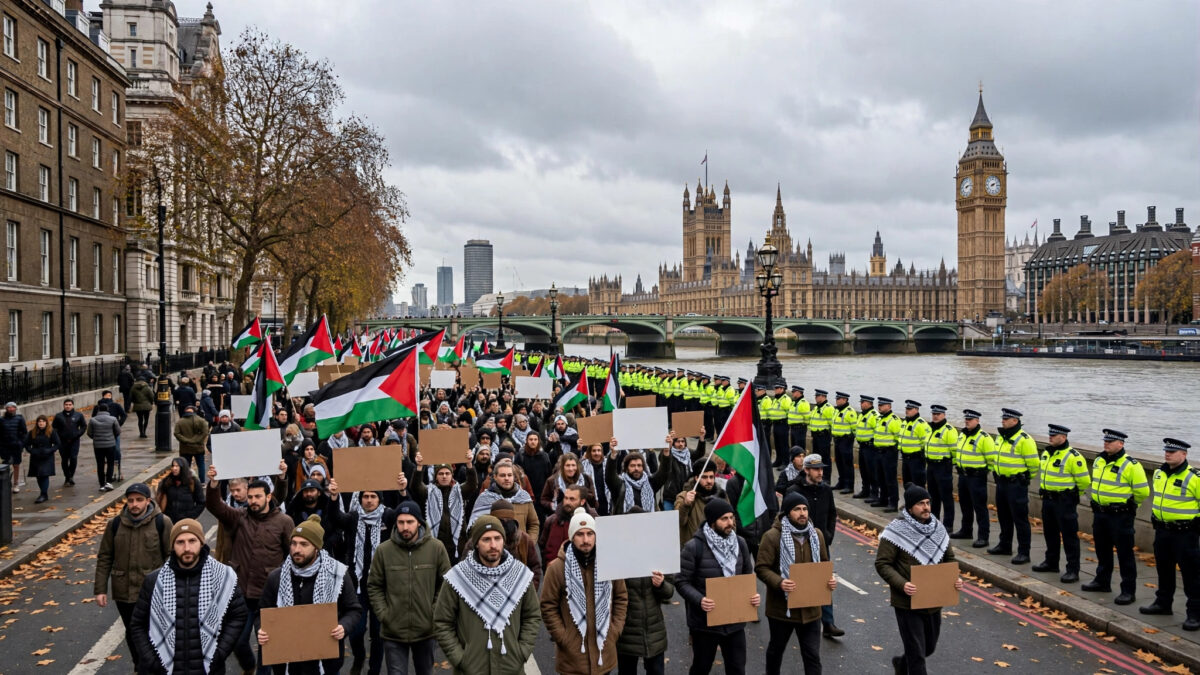
Thousands of pro-Palestine demonstrators are marching through central London today in a national day of action, under one of the most tightly conditioned protest operations the Metropolitan Police has mounted this year.
The Palestine Coalition march assembled on Victoria Embankment from midday before setting off along a police-prescribed route — over Westminster Bridge, down York Road, back across Waterloo Bridge and along the Strand to a rally on Whitehall, which must conclude by 6.30pm. Speeches and music at the rally are required to end half an hour earlier, at 5.30pm.
The Metropolitan Police said it expected between 7,000 and 10,000 people to take part in the day’s events. Conditions were imposed under Sections 12 and 14 of the Public Order Act 1986, legally confining the procession to the specified route and requiring marchers to remain inside a designated assembly area on the Embankment until the march moved off.
A counter-protest organised by the group Stop The Hate is also taking place outside New Scotland Yard, the Metropolitan Police’s headquarters, with assembly required to end by 2.30pm. Police said they had been in contact with representatives of both groups.
The march is the latest in a series of large national demonstrations organised by the Palestine Coalition, an alliance that includes the Palestine Solidarity Campaign, Stop the War, the Campaign for Nuclear Disarmament, the Muslim Association of Britain, Friends of Al Aqsa and the Palestinian Forum in Britain. A parallel National March for Palestine is also being held in Edinburgh from 1pm.
Face coverings and arrest powers
One of the most conspicuous elements of Saturday’s policing operation is the use of face-covering powers. The Met said officers would use Section 60AA of the Criminal Justice and Public Order Act, which allows police to require the removal of items worn to conceal identity — and to arrest those who refuse.
Deputy Assistant Commissioner Carl Galvin, who is leading the operation, said officers would act against groups covering their faces “with the intention to hide their identity, intimidate and commit offences”, describing such conduct as “unacceptable”.
But he drew a distinction for individual cases. “For individual cases, officers must carefully assess why a person is wearing a mask and respond in a measured way,” Galvin said. “Where necessary, they will intervene and enforce the law, recognising that this may sometimes lead to conflict. That is the nature of policing in certain circumstances.”
“On other occasions an arrest may not be the most appropriate course of action in that moment. This is not ‘two-tier policing’ — it is officers exercising professional judgement and acting proportionately based on the facts before them,” he added.
The “two-tier policing” phrase is one the Met has been keen to rebut ever since it became a rallying cry for the force’s critics. Stop The Hate, the counter-demonstration group, made the accusation explicitly ahead of Saturday’s events, posting that the Met “thinks Jewish rights are negotiable” — a claim the force has firmly rejected.
Anniversary shadow
Saturday’s march falls days after the third anniversary of the October 7 attacks on Israel, and the Met has acknowledged that the timing raises the stakes. Galvin said the force knew the event, “so close to the third anniversary of the terror attack on Israel, has the potential to have a greater impact on communities than the previous national marches”.
The anniversary itself saw a tense week of demonstrations in the capital. Eleven people were arrested at pro-Palestine protests on October 7, including five detained on suspicion of inciting racial hatred over slogans chanted outside the Board of Deputies of British Jews in Camden, and several more at a student march near Holborn for breaches of police conditions, including face coverings. Government ministers condemned the anniversary protests: the health secretary called them “shameful”, and the government urged students to “show compassion and protest on another day”.
The Met said there had been 35 large protests organised by the groups making up the Palestine Coalition since October 2023. The majority of those attending, the force said, did so peacefully and lawfully, but arrests had been made “from a small minority” for racially and religiously aggravated public order offences, for stirring up racial hatred and for supporting proscribed terrorist organisations.
“We will continue to take a zero-tolerance approach to hate crime and other offending,” Galvin said.
Conditions explained
The conditions imposed on Saturday’s march are among the most detailed the Met has published for a national demonstration:
- Under Section 14(3) of the Public Order Act 1986, participants must remain within a designated assembly area on Victoria Embankment until the procession begins.
- Under Section 12(3), the procession must not deviate from the route: Victoria Embankment, Westminster Bridge, York Road, Waterloo Bridge, the Strand and Whitehall.
- Marchers must not enter an “emergency access lane” marked out on Westminster Bridge and Westminster Bridge Road, keeping the route clear for emergency vehicles.
- The rally in Whitehall must end by 6.30pm, with speeches and music concluding by 5.30pm.
The force said the conditions were imposed “to minimise the risk of serious disruption to communities” and that the policing presence on the day would be “significant”.
Analysis: Why It Matters
Saturday’s march is, on one level, routine: the 36th large-scale Palestine Coalition demonstration in three years, following a route past the same landmarks and ending with the same rally on Whitehall. But the policing around it tells a story about where Britain now stands — on protest, on the anniversary’s aftershocks, and on a government still defining its posture.
First, the Met is now publishing its protest conditions with a level of legal granularity that reads like a message in itself. Naming the exact sections of the Public Order Act, mapping the emergency access lane, setting separate deadlines for music and for the rally — this is the force showing its working. The subtext is defensive: after three years in which every large Palestine demonstration has been followed by arguments about whether the police did too much or too little, the Met is determined that this time, no one can say the rules were unclear.
Second, the explicit rebuttal of “two-tier policing” is the force fighting a narrative battle it has been losing for months. The phrase has migrated from fringe criticism to mainstream political currency, and Stop The Hate’s counter-demonstration outside Scotland Yard is designed to keep it there. By naming the accusation and answering it in the same statement, the Met is doing something police forces traditionally avoid: arguing about its own legitimacy in advance. Whether that calms the argument or feeds it will be one of the day’s quieter tests.
Third, the face-covering powers mark a genuine escalation in how these marches are policed. Arrests for face coverings were a flashpoint at the October 7 anniversary demonstrations this week; Saturday’s operation makes the mask question an explicit, advertised condition of attendance. Galvin’s careful distinction between groups and individuals suggests the Met knows this is delicate territory — a blanket approach risks inflaming exactly the confrontations the conditions are meant to prevent.
Fourth, the timing places the march at the intersection of two political pressures on the new government. The Burnham administration, barely three months in, has taken a markedly harder public line on anniversary-week demonstrations than its predecessor — ministers calling protests “shameful” and urging students to stay home. Saturday tests whether that rhetoric translates into a different policing reality, or whether the operational outcome looks much like the last government’s: a large, largely peaceful march, a small number of arrests, and a familiar round of argument afterwards.
Finally, the Edinburgh parallel march is a reminder that this is a national, not merely a London, phenomenon — and that policing conditions are not set in Westminster alone. How Police Scotland handles its own march today will invite comparison, fairly or not.
What to watch next
- Arrest figures tonight: the headline number the Met reports after the rally ends will shape the post-march argument. The force’s own framing — “zero tolerance” for hate crime — sets a high bar.
- Face-covering enforcement: whether Section 60AA powers are used, and how, will be the day’s most closely watched policing decision after this week’s anniversary arrests.
- Counter-protest friction: with Stop The Hate assembling outside New Scotland Yard and required to disperse by 2.30pm, the early afternoon is the most likely window for confrontation.
- The slogans question: anniversary-week arrests for “inciting racial hatred” over chanted slogans put the content of Saturday’s speeches under unusual scrutiny.
- Ministerial reaction: whether government ministers comment on Saturday’s march — and in what terms — will signal how the new administration wants to be seen on protest policing.
Sources
- Metropolitan Police – “Met announces conditions for Palestine Coalition protest”
- PA Media via The Oldham Times – “Thousands of pro-Palestine protesters to march through London”
- Hits Radio London – “Arrests warning and strict conditions ahead of pro-Palestine march”
- Met Police via Mynewsdesk – conditions statement

About the Author — Abdul Mannan
Related Articles
Jewish Greens Chair Calls for Polanski to Resign Over “Dereliction of Duty” as Party Crisis Deepens
Vivien Lichtenstein says Zack Polanski should quit as Green leader over the "Zionism is racism" motion, as Caroline…
Ann Widdecombe’s Murder ‘Politically and Ideologically Motivated’ and ‘Inextricably Linked’ to Farage Terror Plot, Court Hears
Prosecutors told the Old Bailey that the alleged murder of Ann Widdecombe and a suspected terrorist plot against…
Britain Renames 187-Year-Old Jerusalem Consulate “UK Mission” in Last-Minute Compromise With Israel
Britain and Israel struck a last-minute deal to keep the 187-year-old Jerusalem mission open under a new name,…