Britain Renames 187-Year-Old Jerusalem Consulate “UK Mission” in Last-Minute Compromise With Israel

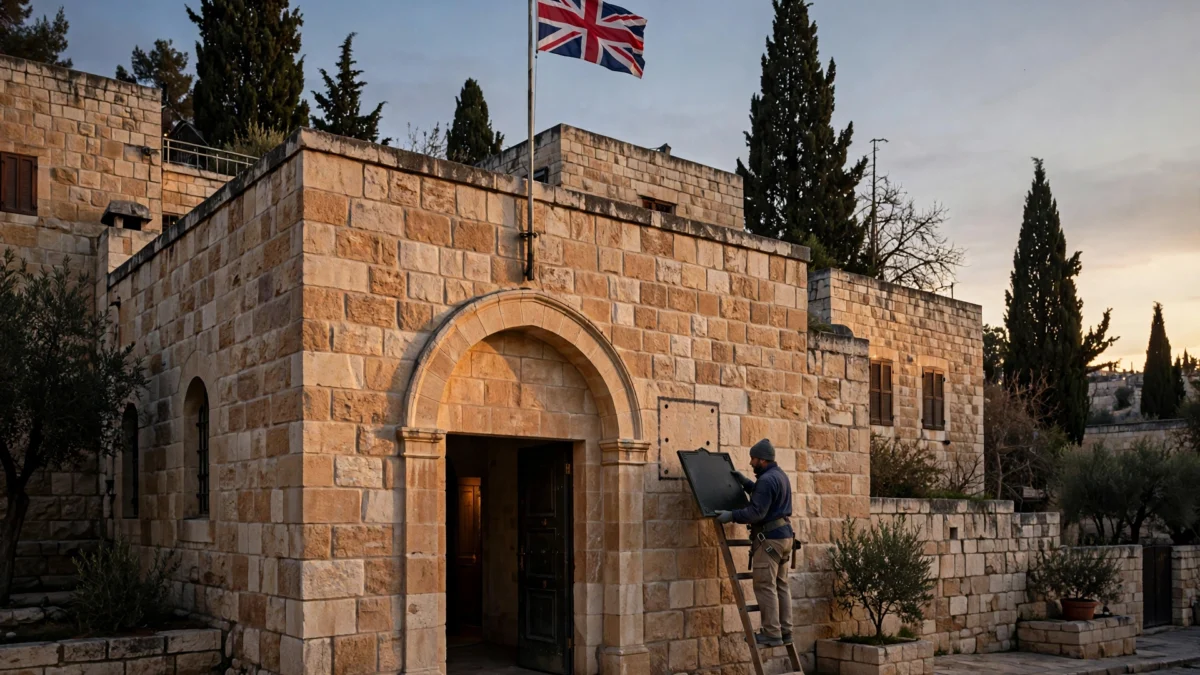
Britain and Israel announced on Thursday a last-minute compromise that keeps Britain’s nearly 200-year-old diplomatic mission in Jerusalem open, renamed as the “UK Mission, Jerusalem” and operating at a sharply reduced scale, just as Israel’s 30-day deadline to shut the consulate expired, according to Reuters.
Under the agreement, reported by Reuters from Jerusalem and London on October 8, Britain will rename the consulate, founded in 1839, as the “UK Mission” in the city. Israel said 20 British diplomats, including the consul general, would depart, leaving just seven working at the mission in a limited role. Britain said it had withdrawn some diplomats “temporarily”, intended to build back its presence, and would hold off on reciprocal measures for now.
The deal, struck on the day the deadline ran out, appeared to ward off a major diplomatic crisis between two longstanding allies. In recent days, sources had told Reuters that Britain had been prepared to consider ejecting Israeli diplomats if the mission were closed.
The symbolism of the day was hard to miss. Reuters journalists in Jerusalem watched workers remove the signs identifying the building as the British Consulate General, including a plaque marking its consular section. The British flag remained flying above the premises.
The dispute began on September 8, when Israel ordered Britain to close the East Jerusalem consulate within 30 days and remove its diplomats from the city. The order was retaliation for Britain announcing sanctions targeting Israeli settlements in the occupied West Bank, including a ban on trade in goods made in the settlements, according to Reuters.
Foreign Secretary Ed Miliband said Britain does not accept that Israel has the legal right to close the consulate, which sits in a part of the city Israel captured in the 1967 war and later annexed in a move most countries do not recognise. “Our Consulate General building will not be closing, and will be known as the UK Mission, Jerusalem from today,” Miliband said, adding that it would continue to “deliver vital services and our work with the Palestinian people.”
In his statement, Miliband said: “We have been clear that we do not accept that the Government of Israel has the legal right to close the British Consulate General in Jerusalem, which has been there for nearly 200 years.” He reiterated Britain’s long-standing view that East Jerusalem is occupied territory, and described the renamed mission as “independent, operational” and continuing Britain’s work with the Palestinian people.
Israeli Foreign Minister Gideon Saar presented the outcome differently. In a statement, Saar said the consulate would formally end operations but that some British diplomats would be allowed to continue working there. “In accordance with the understandings we reached, no measures will be taken against Israel as a result of the implementation of the decisions,” Saar said.
Miliband acknowledged the arrangement was a negotiated necessity rather than a free choice. “Without an understanding, we would not have the necessary assurances for the security and protections of our staff and premises,” he said. “Accordingly, the UK has temporarily withdrawn a number of staff and families to ensure their safety and security. We will work in the coming months to build back up our presence, and we will not take reciprocal action while such discussions are under way and credible.”
The mission at the centre of the row is one of the oldest British diplomatic posts anywhere in the world. It has stood in Jerusalem since around 1839, according to the National Library of Israel, when the area was part of the Ottoman Empire and long before Israel’s establishment in 1948, Reuters reported. Located in the Sheikh Jarrah neighbourhood of East Jerusalem, it handles Britain’s relations with Palestinians in the city as well as in the occupied West Bank and the Gaza Strip, and provides consular services to Palestinians. Britain’s embassy to Israel, like most countries’, is in Tel Aviv.
The compromise lands in the middle of a much wider confrontation. Miliband’s September 8 sanctions package included the settlement-goods trade ban plus measures against British firms supporting settlements, due to take effect next year. In the weeks before the deadline, Britain’s national security adviser Jonathan Powell made an undisclosed visit to Israel in a last-ditch effort to prevent the closure, though a deal then looked unlikely, Reuters reported, citing three sources. A legal brief by former attorney general Dominic Grieve argued Israel has no sovereign right over East Jerusalem as occupied territory and that Britain had a duty to resist under international rulings. Israel also moved against Dutch diplomats’ credentials over the Netherlands’ own settlement-import ban, signalling the dispute could spread to other European missions.
Britain signalled it is playing for time. The Foreign Office said it hopes to resume talks with whichever form of Israeli government emerges from the country’s election later this month, while rebuilding its full diplomatic presence in East Jerusalem as quickly as possible. “The UK stands steadfast by the measures we took on 8 September, in concert with the international community, in support of a two-state solution to deliver peace and security for the people of Israel and Palestine,” Miliband said.
Analysis: Why It Matters
The first thing to understand about Thursday’s deal is that it is, in substance, a defeat dressed as a draw — and both governments are content for it to look like one. Israel can say the consulate, as a consulate, is finished: its signs came down, its consul general is leaving, and twenty of its twenty-seven diplomats are going with him. Britain can say the mission, as a mission, survives: the flag still flies, the building stays open, and seven diplomats keep working. The rename to “UK Mission, Jerusalem” is the diplomatic fiction that lets both claims be true at once.
That fiction matters because of what the building represents. A consulate general accredited to East Jerusalem is not just an office; it is a nearly two-century-old institutional statement that Britain conducts relations with Palestinians separately from its relations with Israel, in a part of the city most of the world considers occupied territory. Israel’s demand was never really about staffing levels. It was about forcing Britain to route everything through Tel Aviv — to treat Jerusalem, in diplomatic practice, as Israel’s undivided capital. Keeping any British flag flying in Sheikh Jarrah, under any name, denies Israel that precedent. That is why Miliband’s line about not accepting Israel’s legal right to close the mission is the load-bearing sentence of the whole arrangement.
The real price, though, is in the numbers. Twenty-seven diplomats down to seven is not a trim; it is a hollowing-out. Consular services, Palestinian engagement, political reporting — all of it now runs on a skeleton crew. Britain’s insistence that the withdrawals are “temporary” and that it will “build back up” its presence is doing a great deal of heavy lifting in a single adverb. There is no agreed timetable, no guaranteed headcount, and the rebuilding depends on the goodwill of an Israeli government that has just demonstrated how it treats goodwill. Watch what happens to that word “temporarily” over the coming months: it is either a genuine plan or the first draft of a permanent downgrade.
The sovereignty question has been deliberately left unanswered, and that is probably the only reason a deal was possible. Miliband asserts Britain does not accept Israel’s right to close the mission; Saar asserts the consulate has formally ended operations. Both statements cannot be true in law, but they do not have to be — yet. The compromise shelves the legal confrontation in favour of a practical one. The risk for Britain is that facts on the ground have a way of becoming law by habit: a “UK Mission” that operates for a year at seven staff starts to look less like a reprieve and more like the new normal, whatever the Foreign Office’s legal position says on paper.
Then there is the wider European dimension, which is where this story may matter most. Britain was not alone in its September 8 move: France and Canada also said they would ban settlement-goods imports, and a joint declaration condemning the settlements drew in more than a dozen European countries. France and Sweden also maintain Jerusalem consulates accredited to the Palestinian Authority. Israel has now established a template — order the closure, force a last-day negotiation, extract a staffing cut and a name change — and every other European mission in the city will be reading Thursday’s outcome as the preview of their own negotiation. The Dutch have already felt the pressure over their import ban. The question now is whether the “UK Mission” model becomes the standard price of defying Israel on settlements.
The timing is not accidental either. Israel votes later this month, and Britain is openly betting that the next government — whatever its composition — may take a different view. That is a reasonable wager but not a safe one: the closure order had broad support in Israel’s political establishment, and no likely governing coalition has signalled enthusiasm for reversing it. Miliband’s promise to stand “steadfast” by the September 8 sanctions, due to take effect next year, sets up the next collision in advance. If the sanctions bite, expect the mission’s staffing and status to become leverage again.
Four things to watch from here. First, the rebuild: does the “temporary” withdrawal actually reverse, and on what timeline? Second, the Israeli election: does the incoming government honour the understanding, or reopen the file? Third, the sanctions: when the settlement-goods ban takes effect next year, does Israel retaliate against the mission again? And fourth, the Europeans: do France, Sweden or Canada face the same treatment — and do they hold the line or take the “mission” deal? Thursday’s compromise averted a rupture. Whether it preserved a principle or merely postponed a surrender will be decided by the answers.
Sources
Reuters — What’s happening with Britain’s Jerusalem consulate? (explainer, October 8, 2026)

About the Author — Abdul Mannan
Related Articles
Labour Holds Starmer’s Old Seat as Green Leader Polanski Falls Short in Holborn and St Pancras By-Election
Labour's Sagal Abdi-Wali has won the Holborn and St Pancras by-election with a majority of 3,364 over Green…

Bank of England Puts a Hedgehog on the Fiver: Wildlife to Replace Churchill and Historic Figures on New Banknotes
The Bank of England has announced a European hedgehog will replace Winston Churchill on the £5 note, with…

Israel to Close British Consulate in Jerusalem on Thursday, Marking New Low in UK Relations, as 11 Arrested at London’s October 7 Anniversary Protests
Israel is set to close Britain's 1838 East Jerusalem consulate on Thursday over the UK's settlement trade ban,…