The Street Has Spoken Again: France’s Yellow Vests Return — and the Ghost of 1789 Walks with Them

How many times must a nation take to its streets before its rulers understand what the street is saying?
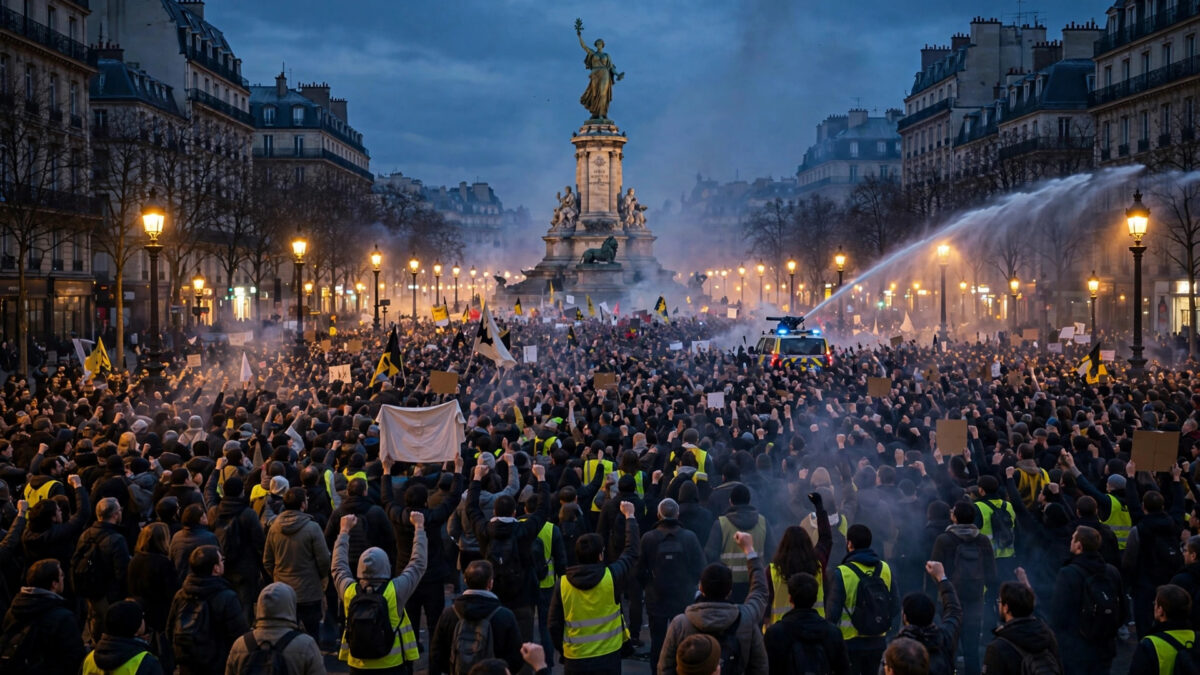
I ask you this question, dear reader, not as a historian, and not as a prophet, but as a student of France — because France has been asking and answering this question for two hundred and thirty-seven years, and every generation in Paris believes it is the first to ask it. On Saturday, the 17th of October, 2026, the smoke rose again over the Place de la République. A car burned. A newspaper kiosk burned. Masked figures threw fireworks and paving stones at lines of riot police, and the police answered with tear gas and water cannon — the old liturgy of the French street, performed once more with the precision of a religious rite.
By three o’clock that afternoon, the Interior Ministry had counted at least 272 arrests. By the evening, the figure was approaching four hundred. The great trade union confederation, the CGT, claimed that half a million people — some of its officials even said eight hundred thousand — had marched across the country from Paris to Marseille, from Lyon to Toulouse. The ministry’s own early tally spoke of 140 protest actions outside Paris by midday, with more than thirty thousand people counted before the largest marches had even set off. The numbers are contested, as numbers always are when the powerful count the powerless. But no one — not the government, not the unions, not the watching world — disputes what the day meant: the Yellow Vests are back.
And if that name sends a small chill down your spine, it should. Because France is the one country on earth where a protest is never just a protest. It is a chapter in a book the whole world has been reading for centuries, and the latest chapter has just been written in tear gas and fire.
The Country That Invented the Street as a Courtroom
There is no nation on this planet that understands the politics of the street the way France does, because France invented it. When the people of Paris stormed the Bastille in July of 1789, they did not merely topple a prison; they toppled the idea that power belongs to palaces. The French Revolution taught the entire human race a single, terrible, unforgettable lesson: when bread becomes unaffordable, the street becomes the parliament, and the verdict of the street is final.
Every French ruler since has lived in the shadow of that lesson. Napoleon Bonaparte, the great general who crowned himself, kept a grape-shot cannon ready for the Parisian mob because he understood what his fellow revolutionaries had unleashed. In 1848, the streets rose again and a king fled. In 1871, the Communards raised their barricades. In May 1968, students and workers brought General de Gaulle — de Gaulle, the liberator of France — to the edge of flight, and the old general had to dissolve the National Assembly and call elections to survive. And in the winter of 2018, the gilets jaunes, the Yellow Vests, rose from the roundabouts of provincial France over a fuel tax and shook Emmanuel Macron’s first presidency to its foundations.
History, my friends, does not repeat itself as farce, as the famous saying goes. History repeats itself as a warning that nobody reads. The men and women who marched on the 17th of October carried the same grievance their ancestors carried in 1789, in 1848, in 1968, and in 2018. They called it different names across the centuries — bread, wages, dignity, the cost of living — but it has always been the same single question: who is this republic actually for?
What Happened on the 17th of October
Let us be precise, because precision is a form of respect. The demonstrations of Saturday were not the work of one organisation or one party. The call spread on social media, urging a revival of the Yellow Vest movement, and it drew together an extraordinary coalition: high-school pupils who have been blockading their schools for four weeks over absent teachers and crumbling buildings; university students; trade unionists of the CGT demanding higher wages and pensions, lower prices, and the protection of public services; farmers; and the veterans of the 2018 gilets jaunes, still wearing their fluorescent vests like medals from a war the state pretends it won.
In Paris, the trouble began at the Place de la République, the very square where the bronze figure of Marianne — the Republic herself — holds her olive branch over the city. There is a symbolism here that no poet could invent: beneath the statue of the Republic, masked protesters set fire to a car and a newspaper kiosk, threw fireworks and paving stones at the police, and the police drove them back with tear gas and water cannon. Shops were targeted for looting. Yet the authorised procession, as the newspaper La Croix reported, advanced peacefully along its approved route toward the Place de Clichy. Two marches, one street, two Frances — and both of them real.
Beyond the capital, the map of unrest read like a roll call of French cities: in Lyon, France’s third city, a tourist office was set ablaze; in Marseille, shops were damaged, a municipal police station was attacked, and protesters briefly entered the lobby of the City Hall; in Limoges, the town hall itself caught fire after a group attacked the building at the end of the demonstration. Rennes, Toulouse, Montpellier, Grenoble, Lille, Angers — the list ran on. The Interior Ministry reported dozens of assaults on officers, damage to public buildings, and looting or attempted looting in several cities. Reuters, that most sober of news agencies, described the unrest as among France’s most destructive in years.
Before the day began, the Paris police prefecture had banned gatherings around the Élysée Palace, the prime minister’s residence at Matignon, and the Champs-Élysées. Several metro stations were closed. The authorities, in other words, knew what was coming — and it came anyway.
“An Empty Fridge Has No Political Party”
Among the many voices of the day, one stayed with me, and I offer it to you as the truest sentence spoken in France this year. Jérôme Rodrigues, one of the best-known faces of the Yellow Vest movement, said this to his followers: “Anger has no political party. An empty fridge has no political party.”
Read that sentence again, slowly. It is the whole of French politics in eleven words. The government, following its usual script, blamed the violence on the ultra-left. The commentators, following theirs, sorted the marchers into their familiar boxes — students, unionists, nostalgists of 2018. But Rodrigues understood what the Élysée refuses to understand: hunger does not carry a party card. The schoolgirl in the northern suburbs of Paris whose classroom has no teacher, the pensioner in Limoges who cannot afford heating, the delivery driver in Lyon watching fuel prices climb week after week — they did not march as left or right. They marched as the forgotten.
And this is what makes the French street so dangerous to those in power: it cannot be divided. You can dismiss a union. You can negotiate with a party. You can even, as Macron’s ministers have tried, criminalise the masks and ban the squares. But you cannot negotiate with an empty fridge, and you cannot arrest a grievance. The moment the street stops belonging to any faction, it belongs to everyone — and a government facing everyone is a government facing the nation itself.
The Numbers the Powerful Fear
Behind the smoke and the slogans lies an arithmetic that no tear gas can disperse. France is in the grip of a fiscal crisis that has been building for a generation. The country’s public finances have been deteriorating for years; investors have been selling French government debt, driving borrowing costs to their highest levels in more than two decades, as reported by Reuters. The prime minister, Sébastien Lecornu, is pressing parliament to approve spending cuts aimed at bringing the deficit down toward five per cent of economic output — and even that modest target is a climb, because France has not balanced its budget since 1973. Let that year sit in your mind: 1973. More than half a century of living beyond its means.
This is the deeper story of the 17th of October. A state that has spent fifty years borrowing from the future has finally arrived at the future — and the future is standing in the street, wearing a yellow vest, asking where the money went. The protesters’ demands are not complicated: wages that keep pace with prices, pensions that preserve dignity, schools that function, hospitals that heal. These are not revolutionary demands. They are the minimum terms of the social contract that the French Republic promised its citizens, and the citizens have noticed that the contract is being honoured in the breach.
Emmanuel Macron enters the final stretch of his presidency presiding over a polarised electorate, a fragmented parliament, and a political class that the street increasingly regards as an occupying force. On Friday, the day before the protests, the president called for calm, reminding the nation that the constitution guarantees the right to protest — while insisting that the right must be exercised with respect for people and property. It was a reasonable statement, and a completely inadequate one. You do not calm a fire with a reminder of the fire code.
The mayor of Paris, Emmanuel Grégoire, condemned the damage while emphasising that the large majority of demonstrators had wanted to march peacefully. He was right, and his honesty deserves recording. The violence, as even the Eurasia Business News correspondent in Paris noted, was the work of smaller groups operating within and around larger demonstrations — treating every one of the hundreds of thousands of marchers as a rioter would be a lie. But here is the harder truth the mayor’s statement cannot erase: peaceful majorities do not burn kiosks, yet peaceful majorities keep marching alongside those who do. When the respectable and the furious walk the same route, the respectable are telling you something. Listen to them.
The Children at the Barricades
There is one part of this story that should haunt every conscience in France, and I will not soften it for you. The student movement that fed into Saturday’s demonstrations did not begin on Saturday. It began in mid-September, in the high schools of Paris’s poor northern suburbs, where pupils protested over teacher absences and shabby, decaying facilities. For four weeks, teenagers blockaded their schools. Thousands were arrested in the September wave. Schools were set on fire. And in the clashes, a fifteen-year-old boy lost a hand — reportedly to a police stun grenade — and the Interior Minister, Laurent Nuñez, was forced to suspend the use of that type of grenade against young demonstrators.
Pause on that image: a child, fifteen years old, losing a hand to the weapons of his own republic, in a protest about whether his school has teachers. If you want to understand why the Yellow Vests found new recruits among the young, you need no further explanation. A state that cannot staff its classrooms but can deploy water cannon against its schoolchildren has made its priorities legible to everyone, including the children.
On the Tuesday before the Saturday march, the climate activist Greta Thunberg joined students at a high school in Saint-Denis. Whatever one thinks of Thunberg, her presence was a signal flare: the school revolt had become an international symbol. And when schoolchildren become symbols, the adults in charge have already failed the only examination that matters.
I speak to you now directly, as one parent of this world to another: there is no political theory, no fiscal target, no deficit percentage that justifies a republic maiming its own children over the price of their education. None. The hand of that fifteen-year-old is the indictment that no minister’s statement can answer.
Why This Is Not Just France’s Problem
You may be reading this in Lahore, in London, in Lagos, in Jakarta, and wondering what the burning kiosks of Paris have to do with you. Everything. Everything, because the disease of which France is showing the symptoms is a pandemic of the political class, and it has infected capitals on every continent.
The pattern is identical everywhere: the cost of living climbs beyond the reach of ordinary wages; public services — schools, hospitals, transport — decay while the wealthy buy their way out of the decay; governments borrow against futures they will not live to see; and when the people protest, they are met first with statistics, then with sermons, and finally with shields and batons. The French are simply further along the curve, because the French have always been further along the curve. France is the canary in the coal mine of Western democracy — except this canary has a two-century history of bringing down governments, and when it stops singing, the mine is already collapsing.
Consider what the street is actually demanding, stripped of every slogan: that work should pay for life; that a child should have a teacher; that the old should not fear the winter bill; that the republic should belong to its citizens rather than its creditors. These are not French demands. They are human demands. Every capital city on earth has its own Place de la République, its own square where the statue of the republic watches over the traffic. The question is whether the rulers still visit those squares — or whether, like the kings of 1789, they have retreated to their own Versailles and left the streets to the people.
And here is the warning that France is sending to the world, free of charge: a political class that answers every protest with the same mixture of contempt and crowd-control will eventually discover that the crowd has stopped asking for answers and started issuing verdicts. The Yellow Vests of 2018 were treated as a nuisance to be managed. The coalition of 2026 — students, unions, farmers, pensioners, the fluorescent-jacketed veterans of the roundabouts — is not a nuisance. It is a census of the discontented. You can manage a nuisance. You cannot manage a census.
The Verdict of the Street
So I return to my opening question: how many times must a nation take to its streets before its rulers understand what the street is saying? The honest answer, the one France’s history forces upon us, is this: the rulers never understand. They are not meant to. The street is not a letter to the government; it is the government’s replacement as the author of events. When half a million people march, the question is no longer what the government will do about the protest. The question is what the protest will do about the government.
There is a legend — historians argue over its truth, but legends are truer than facts — that when Marie Antoinette was told the people had no bread, she replied, “Then let them eat cake.” Whether she said it or not, every French government since has been terrified of sounding like her. Yet terror of the legend has not saved them from re-enacting it. Each generation of the French elite finds its own elegant way of saying “let them eat cake” — in the language of fiscal responsibility, of necessary reforms, of global constraints. The vocabulary changes. The deafness does not.
What happened on the 17th of October was not the end of anything. The fires will be extinguished, the arrests will be processed, the ministers will make their statements, and the deficit will still need cutting. But something has shifted, and the shift is this: the generation that was barely in its teens when the Yellow Vests first rose in 2018 is now marching beside them. The movement has reproduced itself. It has acquired an heir.
A republic that must choose between its budget and its children has already made the wrong choice — the choice was made in the decades of borrowing, not in the days of protesting. The children at the barricades of Saint-Denis, the pensioners of Limoges, the drivers at the roundabouts: they are not the crisis. They are the audit. And audits, as every accountant knows, do not cause the insolvency. They merely reveal it.
France will survive this, as it has survived every one of its street revolutions — the country is indestructible precisely because it is always being destroyed and rebuilt. But the men and women who govern it would do well to remember the lesson their own statues teach: Marianne holds an olive branch, not a baton. The day the republic’s servants need water cannon to walk its own boulevards is the day the republic should ask itself who, exactly, it is still serving.
The street has spoken again. It always does. The only question — in Paris, in every capital, in every square where a statue watches the traffic — is whether anyone in power is still listening, or whether they are merely waiting for the smoke to clear so they can pretend it was never there.
Sources & References
- Fires, clashes erupt across France as protests over living costs intensify — reporting based on the Associated Press, 17 October 2026 (Paris, Lyon, Marseille details; Interior Ministry figures; Macron’s call for calm; student injuries and stun-grenade suspension).
- France in Chaos on October 17: Fierce clashes and fires hit Paris and other cities — Eurasia Business News, Paris correspondent, 17 October 2026 (evening arrest figures; CGT turnout claims via Reuters; Limoges town hall fire; La Croix on the peaceful authorised march).
- CGT estimates over half a million joined protests across France — via BFMTV, 17 October 2026 (CGT turnout estimate; composition of the marches; clashes at Place de la République).

About the Author — Abdul Mannan
Related Articles

How Much Does a Country Cost? The $366 Million Question Over America’s Midterms
Elon Musk has spent $366 million trying to decide America's midterms — and history has seen this auction…
The Two Guns of Bend: When America Armed Both the Killer and the Hero
On October 15, 2026, a 16-year-old shot his way into Silver Rail Elementary in Bend, Oregon, killing three…

They Fired the General Who Counted the Missiles: America’s Empty Quiver in the Iran War
In December 2025, Army Chief of Staff Gen. Randy George warned the Pentagon that America's missile-defense arsenal would…