Ebola Has Reached Nigeria — And the World Is Looking Away Again

What did you hear when the news broke on Tuesday?
I will tell you what I heard. Nothing. A silence so thick you could cut it with a scalpel. Nigeria — Africa’s most populous nation, more than two hundred and thirty million souls, a megacity called Lagos that never sleeps — confirmed its first case of Ebola in the fastest-spreading Ebola outbreak in human history. And the world scrolled on.
Let that settle on your conscience for a moment. Not a rumour, not a drill. A foreign national entered Nigeria on October 5th and fell ill. The doctors, doing what doctors do in West Africa every single day, treated him for malaria. The fever did not break. The treatment did not work. And then, slowly, the terrifying suspicion dawned on the attending physicians: this is not malaria. This is Ebola.
Forty-four contacts are now being traced — mostly healthcare workers, the very people who rushed toward the patient, plus the patient’s spouse, a Swiss national. Forty-four human beings whose names are now on a list in Abuja, waiting to find out whether a handshake, a shared room, a moment of care has written their fate. If you can read that sentence and feel nothing, I do not know what to say to you. Put down this column now. It was not written for you.
The Fever That Pretended to Be Malaria
There is a detail in this story that should freeze your blood, and it is not the one the headlines chose. It is the malaria. The patient was first treated for malaria — because in Nigeria, in that season, in that country, fever means malaria until proven otherwise. This is how Ebola has always moved through human history: wearing a disguise. It arrives as something ordinary. It knocks on the door dressed as the commonplace. By the time the mask comes off, the contacts are counted in the dozens.
Odianosen Ehiakhamen, an assistant director at the Nigeria Center for Disease Control, told local media what happened next: the failure to recover aroused the physicians’ suspicions. Pause on those words. Aroused their suspicions. In the great tradition of African medicine, doctors are asked to be detectives in a war zone, to spot the monster hiding inside the ordinary fever — while the rest of the planet debates other things entirely.
Nigeria’s health machinery moved fast this time; I will grant it that. The contact tracing began. But understand what “tracing 44 contacts, mostly healthcare workers” actually means. It means the people most at risk are the healers. It means that in a country where the doctor-to-patient ratio is already a national emergency, the first casualties of an outbreak are the ones who cannot run away — because their oath will not let them.
And now ask yourself the question nobody in the international press is asking loudly enough: how many people passed through how many airports, bus stations, and border crossings between October 5th and the day of confirmation? The patient entered on the 5th. Confirmation came on the 20th. Fifteen days. Fifteen days in which an invisible killer rode the ordinary currents of human life. That is not a criticism of Nigeria; that is the arithmetic of every pandemic ever known.
I Have Seen This Film Before — And So Have You
Here is where I must hold up the mirror, because that is what a columnist does, and I will not apologise for it. We have seen this film before. We watched it in 2014, when the West Africa Ebola epidemic tore through Guinea, Liberia, and Sierra Leone, infected more than 28,000 people, and buried more than 11,000 of them. We watched the world respond with the urgency of a committee drafting a memo. The virus was contained, in the end, by the courage of African health workers and communities — not by the grand machinery of global health, which arrived late, underfunded, and taking photographs.
Go further back. In 1976, in a small mission hospital in Yambuku, in what was then Zaire, doctors confronted a hemorrhagic fever nobody had ever seen. They named it after a nearby river — the Ebola. Fifty years. Half a century of knowing this enemy exists, of studying it, of watching it kill — and here we are, in 2026, facing the fastest-spreading Ebola outbreak in recorded history, and the most dangerous strain we have is the one for which science has no approved answer.
That is the second thing you must understand about this outbreak, and it is the thing that should terrify every reader of this column, wherever you sit. The 2026 outbreak is caused by the Bundibugyo virus — a rare species of Ebola for which there is no approved vaccine and no approved treatment. Read that again. No vaccine. No treatment. In an age when humanity can edit genes and talk to machines, a virus first identified fifty years ago is outrunning us because the specific form it has taken this time has no pharmaceutical answer. Our only weapons are the old ones: isolation, contact tracing, safe burials, and the bravery of people in yellow suits.
History does not repeat itself, the saying goes — but it rhymes. And I hear the rhyme loud and clear. In 2014, the world discovered Ebola only when it threatened to board a plane to Dallas. In 2020, the world discovered COVID-19 only when it was already inside every capital. And now, in 2026, Ebola is spreading at a speed never before recorded, and the world’s attention is elsewhere. The mirror is held up. Look into it. What do you see?
The Fastest Ebola in History — The Numbers Nobody Wants to Read
Let me give you the numbers, because numbers are the one language that panic cannot distort. The outbreak was first detected in the Democratic Republic of Congo in May — though the World Health Organization believes it had been spreading, undetected, for months before that. Think about that phrase: spreading undetected for months. The fastest Ebola in history was already running before anyone blew the whistle.
Since then it has infected more than 9,500 people and killed nearly half of them, according to Associated Press reporting — the fastest-spreading Ebola outbreak in history. The United States CDC counted 9,582 confirmed cases and 4,605 confirmed deaths through October 20th; Reuters, with slightly newer figures, put the death toll at 4,646, as reported by The American Quorum. Nearly one in two. Flip a coin. That is the mortality arithmetic of Bundibugyo in 2026.
And now the geography, which is the true horror of this story. This is no longer a Congolese outbreak. It is in three regions of Africa: Central Africa (the DRC, where in parts of North Kivu health authorities say the disease is out of control and contact tracing cannot keep pace with the spread), Eastern Africa (Uganda, which declared itself Ebola-free in July after 20 cases, and Kenya, which has recorded nine), and now Western Africa — Nigeria. Kenya’s first patient had lived in the DRC, travelled by road to Kampala, and then flew to Nairobi: three countries before a single test was run. France has also recorded a case. The virus is not respecting borders. It never has. Borders are a human invention; viruses never signed the treaty.
Dr. Jean Kaseya, the director general of the Africa CDC, said it plainly on Wednesday as he summoned African health ministers to an extraordinary virtual meeting on October 28th: “Ebola is now affecting three regions of Africa. The situation demands urgent action and political leadership at the highest level.” He has described this as the most geographically extensive Ebola outbreak in history. The WHO, on the same day, advised all countries in the region to sustain a high level of readiness as the DRC outbreak continues to evolve. These are the sentences institutions write when they are frightened and trying not to show it.
Denial Is the First Symptom — Not of the Virus, of Us
And here is where the columnist must do the uncomfortable part of his job, because the facts alone do not explain why this keeps happening. The uncomfortable part is this: the first symptom of every pandemic is not fever. It is denial.
Uganda, which declared itself Ebola-free in July, has denied that Nigeria’s first case originated on its soil. Perhaps it did not. Perhaps it did. But notice the reflex: when the plague knocks, the first instinct of the powerful is to insist it came from somewhere else. I have watched this reflex my entire professional life. It is the same reflex that made governments in 2020 argue about where a virus was “from” instead of what to do about it. Blame is the narcotic of the unprepared. While officials trade denials, the virus trades in handshakes.
And what of the rest of us — the comfortable, the distant, the scrolling? In 2014, Ebola became a global story for about six weeks, and then it became an African story again, which is to say it became nobody’s story. The 11,000 dead were mourned by their families and forgotten by the algorithms. The treatment centres were dismantled. The funding dried up. The lesson was filed away under “resolved.” And now the fastest Ebola in history is moving through the most connected continent on earth, and the world’s great powers are — what, exactly? Issuing statements. Scheduling virtual meetings. A virtual meeting, on October 28th, eight days after Nigeria’s first case. The virus does not attend virtual meetings. The virus does not wait for the calendar.
Do not misunderstand me: the Africa CDC is doing its job, and Dr. Kaseya is right to summon the ministers, and the talks will feed into a summit of African heads of state led by Burundi’s President Évariste Ndayishimiye, the current African Union chairperson, as reported. Coordination across borders is exactly what is needed, because the virus has already crossed several. But coordination is what you do before the fire reaches the fourth country, not after. The meeting is necessary. The meeting is also late. Both things are true, and a serious person must hold both.
You, the reader — yes, you, wherever you are reading this — I want you to notice something about your own reaction. When you read “Ebola in Nigeria,” did some part of your mind file it under “Africa’s problem”? Be honest. That filing cabinet is where pandemics go to grow. COVID-19 was filed under “China’s problem” in January 2020. By March, the filing cabinet was on fire and so was everything else. The distance between “their problem” and “our problem” is exactly one international flight — and this virus has already demonstrated, via a patient who travelled from the DRC through Uganda to Kenya by road and air, that it knows how to fly.
What Nigeria Faces — And What the World Owes It
Nigeria is not Guinea in 2014. Say this clearly, because panic is as useless as indifference. Nigeria has a Nigeria Center for Disease Control with real capacity. It contained Ebola in 2014 with a speed that surprised the world — the famous story of the index case in Lagos, the contact tracing, the containment. Nigeria knows this enemy. Its doctors spotted the disguise this time, too: they noticed the malaria treatment failing, and they raised the alarm. That is professionalism under pressure, and it deserves to be named.
But Nigeria is also Lagos: more than 15 million people pressed together in one of the densest urban agglomerations on the planet, a city where social distancing is a fantasy and contact tracing is a war. Nigeria is a country where the healthcare system, for all its courage, is stretched to breaking by the ordinary burdens of the ordinary day. Ebola does not attack the strong points of a health system. It attacks the gaps. And every health system on earth has gaps.
Here is what the world owes Nigeria, and the DRC, and Uganda, and Kenya — not charity, but debt repayment. When the Bundibugyo strain has no vaccine, that is not an act of God. That is a consequence of where research money goes and where it does not. The world spent billions developing COVID vaccines in under a year when the virus threatened London and New York. Ebola has killed thousands of Africans across five decades, and the rare strain now racing across three regions still has no approved vaccine. Follow the money, and you will find the moral of the story. The pharmaceutical industry does not hate Africa. It is worse than that: it does not think about Africa at all — until the virus buys a plane ticket.
I am not a scientist. I am a columnist, and my laboratory is history. And history teaches that the bill for indifference always arrives, and it always arrives with interest. The 2014 epidemic cost the three worst-hit countries an estimated billions in economic damage. The cost of containing this one, if it escapes Nigeria’s grasp, will make that look like a rounding error — because Nigeria is not a small country on the periphery of the global economy. It is Africa’s largest economy and its most populous nation. If Ebola establishes itself in Lagos, the economic shockwave will reach every market on earth, including yours.
The Verdict
So here is my verdict, and I deliver it the way my columns have always delivered verdicts — not as a summary, but as a warning.
The virus is faster than our memory. That is the whole story. Humanity’s memory of 2014 lasted about as long as a news cycle. Humanity’s memory of COVID lasted about as long as the mask mandates. And now a virus with no vaccine is moving through Nigeria, and the world is responding with the speed of a scheduled virtual meeting. We have not learned. We have not changed. We have simply gotten better at being shocked.
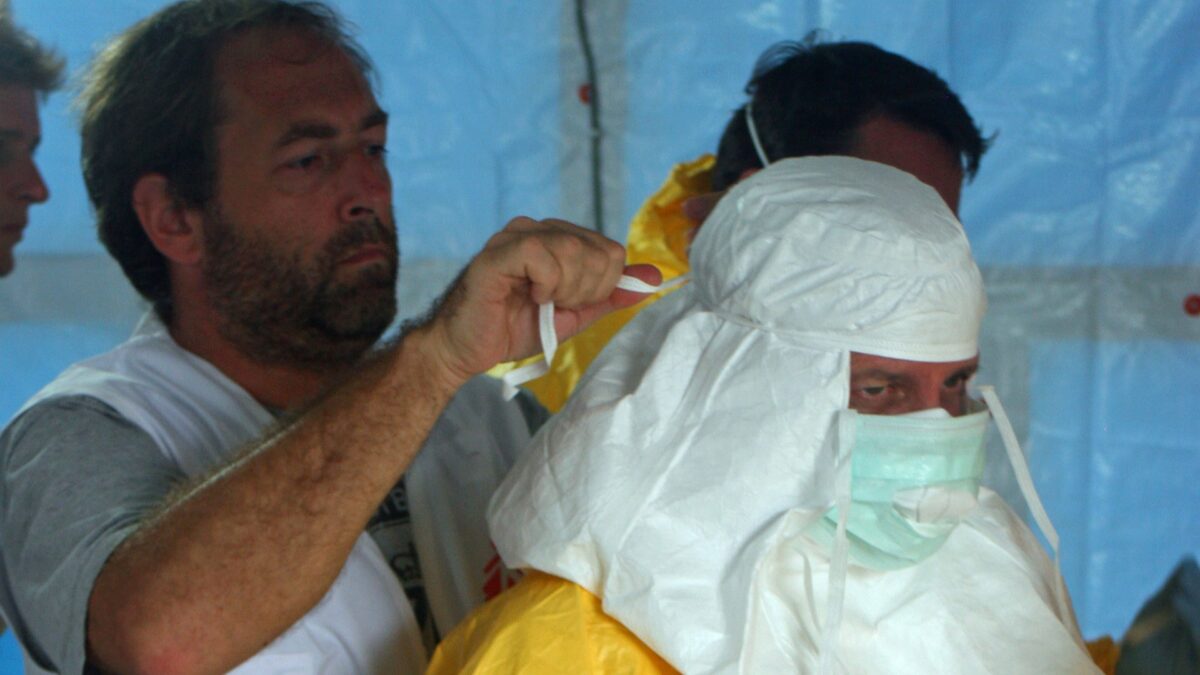
But there is another memory, older and worthier, and I will end with it. In every Ebola outbreak in history, the people who stood between the virus and the rest of us were not the powerful. They were the nurses who stayed at the bedside, the contact tracers who walked into villages, the burial teams who did the most dangerous work of all with dignity and care. The MSF worker tying a colleague’s mask before entering the treatment unit. The Nigerian physician who looked at a “malaria” patient and thought: something is wrong here. These are the people on whose courage the arithmetic of survival depends — not 9,582 cases, not 4,605 deaths, but the individual decision, made ten thousand times a day, to walk toward the danger instead of away from it.
Honour them. Fund them. Do not make them fight the fastest Ebola in history with the slowest response in history. The fever that pretended to be malaria is now showing its true face. The only question left is whether we will show ours.
Sources & References
- Associated Press / Medical Xpress — “Africa CDC calls an Ebola crisis summit as Nigeria records its first case” (Oct 21, 2026): first case details, 44 contacts traced, Oct 28 extraordinary meeting, 9,500+ cases, fastest-spreading outbreak in history.
- Associated Press / BusinessMirror — same-day coverage: Uganda denial, patient entered Nigeria Oct 5, initially treated for malaria, spouse a Swiss national, Kenya’s nine cases.
- Associated Press / The Reflector — Kaseya’s “three regions of Africa” statement, WHO readiness advisory.
- Madhyamam — Bundibugyo virus has no approved vaccine or treatment; France also recorded a case; North Kivu “out of control”.
- The American Quorum — US CDC figures (9,582 cases, 4,605 deaths through Oct 20), Reuters’ newer toll of 4,646, Nigeria the fourth African country affected.
- CBNC — Kaseya: “most geographically extensive in history”; outbreak began in DRC in May after months of undetected spread.
- Joseph Mmwa — Kenya patient’s three-country journey (DRC–Uganda–Kenya); AU heads-of-state summit under Burundi’s President Évariste Ndayishimiye.
- Wikimedia Commons — Featured image: “Preparing to enter Ebola treatment unit” (CDC Global / Athalia Christie, CC BY 2.0).

About the Author — Abdul Mannan
Related Articles
The Frozen Map: Ukraine’s 75-Percent Peace Gamble and the Ghosts of History
What is the price of a country? Not the whole country — just twenty-five percent. Zelensky's "freeze and…
The Last Phone Call: What Prince Harry’s Regret Teaches Us About Grief, Guilt, and the Words We Never Said
Prince Harry told GQ his biggest regret is the last phone call he ever had with his mother,…

The Machine That Solved the NSA’s 25-Year Secret in 30 Minutes
Twenty-five years of suspicion about the NSA's hidden numbers beneath global encryption — ended in thirty minutes by…