Bronson Reed Is Dead at 38 — and the Roar of the Crowd Has Gone Silent

What do you say when the mountain falls?
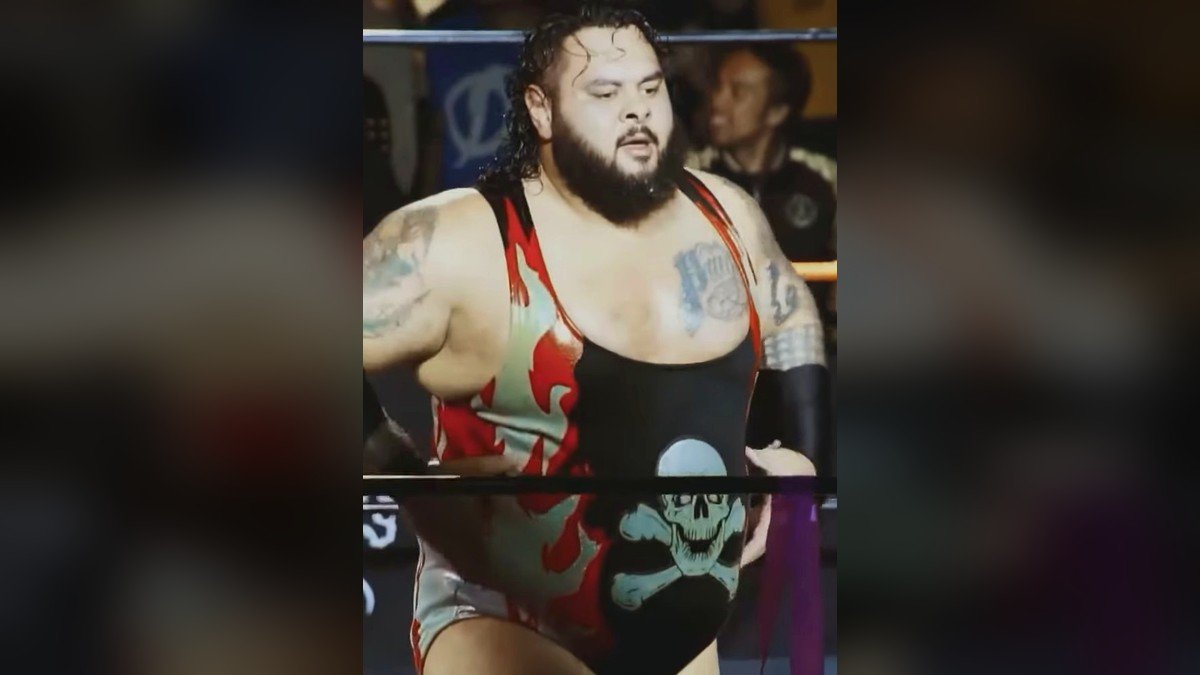
Not the mountain of stone, but the mountain of a man. A man who stood six feet tall and weighed 330 pounds, a man whose very entrance made arenas shake, whose splash from the top rope — the Tsunami, they called it — felt like a wave breaking over the crowd. On Friday, the 27th of November, 2026, the company he gave his body to announced that Jermaine Haley, the man the world knew as Bronson Reed, was dead. He was thirty-eight years old. He leaves behind a wife, Paige, who is pregnant with their second child, and a little daughter who will now grow up with only stories of her father.
I ask you, reader, to sit with that sentence for a moment before you scroll on. Thirty-eight. A pregnant wife. A daughter. A second child who will never meet his father. This is not a headline. This is a house with the lights suddenly gone out, and the wrestling world is standing outside in the dark, holding candles and asking questions that have no answers yet.
And yet we must ask them. Because when a man dies at thirty-eight, three weeks after being thrown through tables on a stage in Riyadh, silence is not respect. Silence is surrender.
The Announcement That Stopped the Wrestling World
WWE’s statement was short, and its shortness said everything. “WWE is devastated to announce that Jermaine Haley, known to WWE fans as Bronson Reed, passed away earlier today at the age of 38 due to medical complications,” the company said on Friday. “Our thoughts and deepest condolences are with Jermaine’s entire family, including his pregnant wife, Paige, their daughter, as well as all his friends, co-workers and fans.”
There was no cause of death beyond those two words: medical complications. No further detail. The company called him a larger-than-life figure, a phenomenal person, a devoted family man, a beloved colleague. Within hours, the announcement had become one of the most engaged-with posts in wrestling history. WWE’s official in-memoriam post on Instagram drew more than 1.1 million likes and 67,000 comments in its first day, and a memorial video on Facebook drew tens of thousands more. Fans who had cheered him only weeks earlier were now writing the same two words over and over: rest in peace.
But beneath the grief, another current was already running, and it is the current this column cannot ignore. Many fans were not only mourning. They were angry. They were pointing at one night, one spot, one fall. And they were asking, in public, whether the business that made Bronson Reed a star had also asked too much of his body.
Let me be precise, because precision is a duty when a man is dead and blame is in the air. WWE has not said that his injuries at Crown Jewel caused his death. No doctor has spoken publicly. No report has established a link. What we know is a timeline, and the timeline is what makes the questions unavoidable.
From Adelaide to the Brightest Lights in the World
Before he was Bronson Reed, he was a boy from Adelaide, South Australia, born on the 25th of August, 1988, into a family of Samoan descent. Jermaine Haley played Australian rules football, soccer, rugby and basketball as a child, and he carried a lifelong love for the Port Adelaide Football Club. But the ring called him early, and he answered. He made his professional wrestling debut in 2007, at nineteen, under the names Jonah Rock and J-Rock, and he spent eleven long years working the Australian independent circuit — Wrestle Rampage, Explosive Pro Wrestling, Melbourne City Wrestling — collecting championships the way other men collect pay cheques: three times the Wrestle Rampage Australian National Champion, and a shelf of heavyweight titles besides.
He toured Japan with Pro Wrestling NOAH. He worked Britain, Germany, and the American independents. He was, in the truest sense, a wrestler made the hard way, in small halls, far from the bright lights, learning his craft one bruised body at a time.
In January 2019, WWE signed him. He reported to NXT, the company’s developmental brand, and by June of that year he had a new name: Bronson Reed. The name fit the man — big, blunt, and built like something carved out of the Australian outback. He fought through the NXT Breakout Tournament, and on the 18th of May, 2021, he defeated Johnny Gargano inside a steel cage to win the NXT North American Championship. It was the summit of his first run, and it should have been the beginning of something larger.
Instead, three months later, in August 2021, WWE released him. It was one of those decisions that the business makes without explanation and the wrestler must live with. Reed did not vanish. He went back to the world as JONAH, working Impact Wrestling and New Japan Pro-Wrestling, reminding everyone who would watch that he was still there, still dangerous, still very good at the thing he had given his life to.
And then, on the 19th of December, 2022, he came home. He returned to WWE on Monday Night Raw, coming to the aid of The Miz, and the crowd that had never forgotten him roared as if he had never left. In 2024 he won the André the Giant Memorial Battle Royal, a victory named for the most famous giant the business ever produced — a fitting honour for a man who wrestled like a giant himself. He broke his ankle at WarGames later that year and spent more than six months out of action. He came back in the summer of 2025 and joined The Vision, the powerful stable built around Seth Rollins and Bron Breakker, and he was, by every measure, exactly where he belonged: on the biggest stage, in the biggest stories, doing the biggest work of his career.
That is the arc. Nineteen years, from a teenager in Adelaide to a main-event player in the largest wrestling company on Earth. And it ended, on a Friday in November, at thirty-eight.
The Night in Riyadh
The last time the world saw Bronson Reed perform was at Crown Jewel, in Riyadh, Saudi Arabia, on the 7th of November, 2026. He was not even on the card. He interfered in the World Tag Team Championship match, in which Penta and Je’Von Evans challenged The Vision’s Bron Breakker and Austin Theory, and the chaos that followed spilled into a brawl with Oba Femi. Reed was thrown off the stage and through tables, and something went badly wrong.
According to multiple reports, he suffered multiple broken ribs and a lacerated kidney, and he stayed behind in Saudi Arabia for further medical treatment while the rest of the WWE roster flew home. Dave Meltzer of the Wrestling Observer reported that he had also suffered a punctured lung. Fightful’s Sean Ross Sapp was the first to report the injury. A week before his death, Bryan Alvarez reported that Reed had made it home and was “continuing his recovery from surgery.”
Those are the reported facts. Here is the honest part, the part I will not dress up: nobody outside his family and his doctors knows whether those injuries had anything to do with his death, and WWE has not said so. What I know is that the fans saw a man thrown through tables on the 7th of November and heard he was dead on the 27th, and the human mind connects those two dates the way the eye connects two stars into a constellation. The connection may be real, or it may be an illusion. But the question it raises is real either way, and it is older than wrestling itself: how much of a man’s body are we entitled to watch him break for our entertainment?
The Arena Is as Old as Rome
Here is where history holds up its mirror, and I ask you to look into it with me, because this is the heart of the matter.
Two thousand years ago, in the Colosseum, the Roman crowd gathered to watch men fight and die for their pleasure. The poet Juvenal gave it a name that has outlived the empire itself: bread and circuses. Give the people food and spectacle, and they will ask no questions about the price. The gladiators were athletes and slaves at once, admired and owned in the same breath, cheered in the arena and forgotten outside it. The crowd demanded bigger spectacles every year, higher falls, sharper blades, closer brushes with death, and the men in the sand paid for the crowd’s appetite with their bodies.
Do not tell me we are different. We are not different. We have only changed the sand for a canvas, the sword for a steel chair, the lions for a fall through a table from a stage. The appetite is the same. Every year, the spots grow more dangerous, the falls grow higher, the tables grow more numerous, because the crowd, having seen a man fall through one table, demands that the next man fall through three. And the men who perform, who love the roar the way a singer loves applause, keep saying yes, because the roar is the thing they live for, and because saying no means stepping aside while someone braver takes your place.
I am not saying that wrestling killed Jermaine Haley. I have no evidence for that, and I will not invent it. I am saying something larger and more uncomfortable: that a business built on the spectacle of human bodies in danger will, sooner or later, bury a man whose body gave out, and the crowd will be left holding its applause and wondering what it was applauding. The gladiators knew the bargain they had made. The question is whether we, the audience, know the bargain we have made with them.
Bronson Reed’s finishing move was called the Tsunami — a splash from the top rope, all 330 pounds of him crashing down onto his opponent. The crowd loved it, because it looked like a force of nature. But a tsunami, for all its power, is still water, and water breaks against the shore eventually. Every body breaks eventually. That is not philosophy. That is physics.
Thirty-Eight: A Number Wrestling Knows Too Well
There is a cruelty in the number thirty-eight, and wrestling fans will feel it before anyone else does, because thirty-eight is a number this business has buried before. Eddie Guerrero, one of the greatest performers who ever lived, died on the 13th of November, 2005, at thirty-eight, of heart failure, in a hotel room in Minneapolis, days before he was scheduled to challenge for the world championship. Twenty-one years later, almost to the week, another thirty-eight-year-old is gone. The calendar itself seems to be mocking us.
And the list, once you start it, is a wound that will not close. Bray Wyatt, dead in 2023 at thirty-six, of a heart attack, weeks after he had been cleared to return. Owen Hart, dead in 1999 at thirty-four, falling from the rafters of an arena in Kansas City in front of a live crowd. The names pile up like headstones in a yard the business would rather not visit, and every one of them was a man in his prime, a man with a family, a man the crowd believed would be there forever, because the crowd had never learned to imagine the show without him.
That is the terrible illusion of professional wrestling: it makes its performers look indestructible. They rise from finishers that would hospitalise an ordinary person. They are thrown through tables and stand up smiling. They bleed, and then they pose. Night after night, the show teaches you that these men cannot be broken, and then one morning the news teaches you otherwise, and the shock you feel is the measure of how completely you believed the illusion.
Jermaine Haley was not indestructible. He was a man from Adelaide who had a bad back, a broken ankle, broken ribs, a lacerated kidney, and a heart that beat for his wife and his little girl. The costume made him a giant. The man inside it was mortal, like all of us, and he died at thirty-eight, which is no age at all for a man to die.
The Questions We Must Ask, and the Ones We Must Not
Now, in the days after a death like this, two kinds of talk begin, and we must be honest about which one serves the dead and which one serves only ourselves.
The first kind is the question of safety, and it must be asked, loudly, and by people with the power to change things. Was the spot at Crown Jewel too dangerous? Who approved it? What medical care did Reed receive in Riyadh, and what did his recovery look like when he came home? What does WWE’s duty of care look like when a performer is injured on a show in another country and then flown home to recover largely out of the public eye? These are questions for the company, for the regulators, for the journalists who cover this business with the seriousness it deserves. They are not questions for the comment section, and they cannot be answered by a hashtag.
The second kind of talk is blame, and it must be resisted. Already, in the comments under WWE’s own memorial posts, fans are pointing fingers at Oba Femi, the man who threw Reed through the tables, as if a single wrestler choreographs his own spots and bears the weight of another man’s death alone. That is cruelty dressed as justice. Oba Femi performed a spot that was planned, approved, and rehearsed as part of a show, and there is no evidence he did anything other than what the show asked of him. To turn a grieving colleague into a villain is to protect the system by sacrificing a man, and the system is very good at that trick. Do not help it.
There is also a smaller, uglier argument running through the comments — fans claiming the voiceover on WWE’s televised tribute sounded artificially generated, and calling that disrespectful on a night when the show was pre-taped around the Thanksgiving holiday. I will not amplify that claim beyond noting that it is being made, because it is a distraction from the only thing that matters, and the only thing that matters is a dead man and the family he left behind.
So ask the hard questions of the institutions. Do not hand the blame to the nearest wrestler. And above all, do not turn a man’s death into content. The difference between a tribute and a spectacle is the difference between remembering a man and using him, and the internet, in its grief, very often cannot tell the two apart.
What Remains: A Wife, a Daughter, and a Child Unborn
Let us end, then, not with the business, but with the house in which the lights have gone out.
Paige Haley is pregnant with the couple’s second child. Their daughter is still small. There is a baby coming into this world who will never hear his father’s voice except on a screen, who will learn who Jermaine Haley was from photographs and video clips and the stories other people tell. That is the part of this story that no championship, no battle royal, no standing ovation can ever repair. A title can be vacated and won again. A father cannot.
I think of the nineteen years. A boy in Adelaide, dreaming of the ring. Eleven years on the Australian independents, where the pay was small and the crowds were smaller. A signing, a name, a championship, a release, a long road back through Japan and the independents, a return, a battle royal named for a giant, a place at the top of the card. Nineteen years of a man building a life with his body, and the body kept its receipts.
And I think of the last weeks of that life: injured in Riyadh, treated far from home, flown back to recover, and then gone, in the space of three weeks, with the official explanation amounting to two words. His family deserves more than two words. They deserve a full and honest account of what happened to him, and if the business cannot give them that, then the business has failed at the one moment when it mattered most.
The Roar Has Gone Silent
So what do you say when the mountain falls?
You say the man’s name. Jermaine Haley. Not the character, not the brand, not the catchphrase, but the man: a son of Adelaide, of Samoan blood, a husband, a father, a wrestler who gave nineteen years to a business that asks everything of the people who love it. You remember that the roar of the crowd is a beautiful thing, and that it is also a debt, and that every debt comes due. You remember that thirty-eight is no age to die, and that a pregnant wife and a little girl are not a storyline, and that the second child who is coming will need this world to be a kinder place than the one his father left.
And then, reader, you look at the spectacle you love, and you ask it the question the Romans never asked, and that we must ask now: what are we willing to change, so that the next mountain does not fall at thirty-eight?
Because if the answer is nothing, then we have not mourned Jermaine Haley at all. We have only watched him fall, the way we watched him fall through those tables, and then we have waited for the next match to begin. The Romans watched the games and went home. We can do better than the Romans. We must. The man from Adelaide deserved better than to be another name on the list, and his children deserve a world that remembers him as more than a moment of silence before the show goes on.
Rest in peace, Jermaine Haley. Rest in peace, Bronson Reed. The tsunami has gone out to sea, and the shore is quiet now.
Sources & References
- CNN — “WWE star Bronson Reed dies at 38 due to ‘medical complications'” (27 November 2026)
- Bleacher Report — “WWE’s Bronson Reed Dies at Age 38 ‘Due to Medical Complications’ Following Crown Jewel” (27 November 2026)
- TheWrap — “Bronson Reed, WWE Star, Dead at 38” (27 November 2026)
- Entertainment Weekly — “WWE star Bronson Reed dies at 38” (27 November 2026)
- Wikipedia — “Bronson Reed” (career record, biography and championships)
- WWE on Instagram — Official in-memoriam announcement for Jermaine Haley, “Bronson Reed” (28 November 2026)

About the Author — Abdul Mannan
Related Articles
When the State’s Own Door Was Locked: Britain’s Benefits System and the Cyber Siege Nobody Saw Coming
On the night of 26 November 2026, a cyberattack forced Britain's Department for Work and Pensions to shut…
One Week On, GTA 6 Has Not Just Broken Records — It Has Moved the Centre of the World
Grand Theft Auto VI launched on 19 November 2026. One week on, it has sold an estimated 53…
Elon Musk Has Given Every American Child Two Shares of SpaceX — and a Stake in the Future Itself
On 25 November 2026, SpaceX announced it would give one share to every American child in a Trump…