Houthi Campaign Widens to Dammam as Riyadh Death Toll Rises to 13, Trump Weighs US Strikes

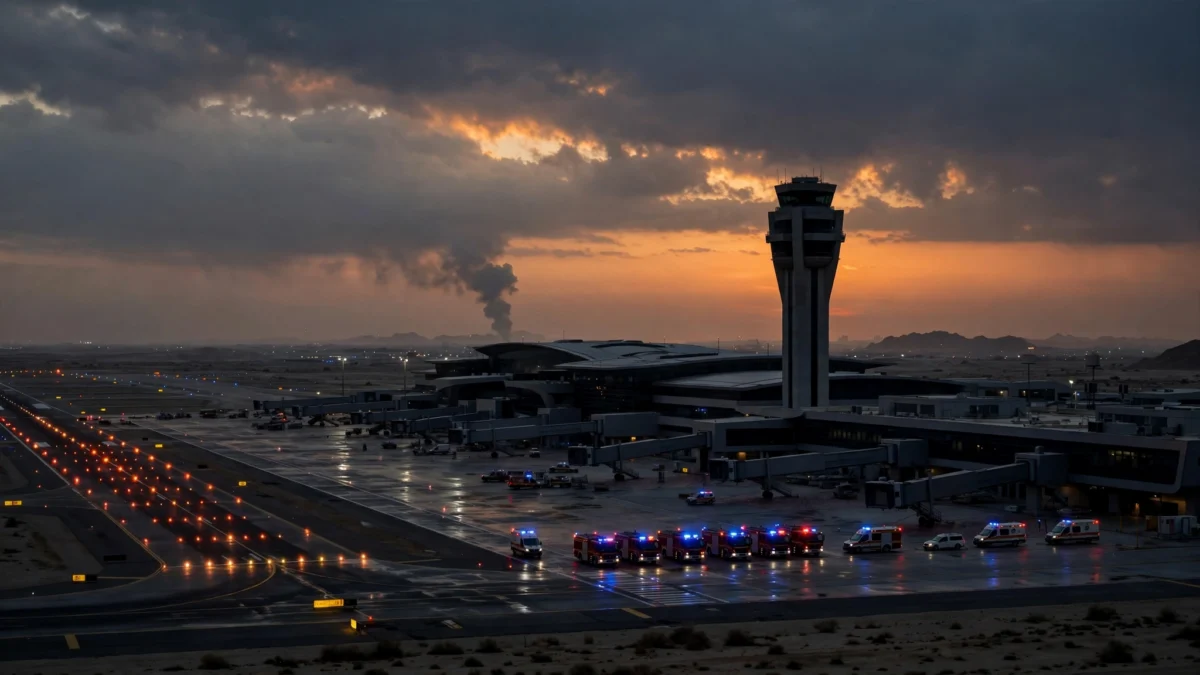
The Houthi campaign against Saudi airports widened dramatically on Sunday, as the country’s General Authority of Civil Aviation (GACA) confirmed that King Fahd International Airport in the eastern coastal city of Dammam had come under attack that evening — a second airport struck in a single day, some 400 miles from the capital. The confirmation capped the most violent weekend in the kingdom in more than a decade, according to CNN, and came hours after an Indian national wounded in Saturday’s missile strike on Riyadh’s King Khalid International Airport died of his injuries, raising the death toll from that attack to 13, according to the Indian embassy in Riyadh.
GACA said authorities were assessing damage at the Dammam facility and conducting safety inspections, according to CNN, which also reported that the Houthis had claimed to have targeted the airport. In Riyadh, the Saudi-led coalition said a projectile had struck Terminal 4 earlier on Sunday, setting it on fire, while Saudi air defences intercepted a cruise missile in the airport’s vicinity, according to CNN. Civil aviation officials said the Riyadh attack produced injuries but did not specify a number, and that damage assessments were continuing.
The twin Sunday attacks — the fourth and fifth strikes on Saudi airports in about a week, according to The Times — followed Saturday’s devastating missile strike on Riyadh airport that killed at least 13 people, including four Saudis, two Bangladeshis, an American, and citizens of Egypt, Jordan, Syria, Palestine and Sudan, with 309 wounded, according to Saudi authorities as reported by CNN. The attack was the deadliest on Saudi territory in more than a decade, and The Times described it as the deadliest attack on Saudi territory in decades.
Speaking to reporters outside the White House on Saturday, US President Donald Trump said Washington was reconsidering a direct military role after previously declining repeated Saudi requests. “We may. We’re going to look at it,” Trump said, according to CNN. “We just found out about the recent attack. So we’ll make a decision. We move very quickly.” Trump added that he planned to speak with Saudi Crown Prince Mohammed bin Salman, and said of the Saudis: “They’re able to defend. The Saudis are good fighters. But I think the attack was a terrible thing.”
CNN reported that just last month Trump had rejected two appeals from the crown prince for US strikes against the Houthis. The Times noted that the United States had previously agreed a ceasefire with the Houthis after a month-long bombing campaign, and that neither side appeared eager to resume the conflict.
The Houthis publicly embraced the escalation. In a televised speech on Sunday, the group’s military spokesman Yahya al-Saree claimed responsibility for Saturday’s strike on Riyadh and said the group had also attacked the airport in Dammam and two facilities belonging to Saudi oil giant Aramco, according to Reuters reporting carried by US media. Neither Saudi Arabia nor Aramco had confirmed the claimed Aramco attacks when Reuters reported, and Reuters said it had reached out to the Saudi media office and to Aramco for comment. Saree also reiterated a stark warning to the aviation industry: “We urge everyone to take our warnings seriously, and Saudi Arabia bears responsibility for any failed interceptions,” he said, according to the Reuters report, adding that “worse is yet to come” if Saudi military action in Yemen continued.
According to The Times, Saree wrote on Telegram that the Houthis “reiterate their warning to all airlines, staff, and travellers to refrain from using Saudi airports and airspace,” adding that airports in the Muslim holy cities of Mecca and Medina were exempt. A Houthi military statement cited by CNN used similar language, warning that Saudi Arabia would “bear responsibility for any failed attempts to intercept” missiles, and vowing to continue responding to “blockades with blockades, and escalation with escalation.” Nasr al-Din Amer, a senior Houthi official, appeared to acknowledge the Saturday attack in a post on X, writing: “We shut down Riyadh international airport,” according to CNN.
The kingdom is not facing the Houthis alone. The Times reported that Saudi Arabia had leaned on Pakistan and Turkey — which signed a defence pact earlier this year — for support, and that both countries were expected to send troops to support Saudi Arabia. The Times also reported that Syria had sent drone operators to the government-controlled port city of Aden in Yemen, and that the United States had already sent military and intelligence operatives to Saudi Arabia to assist with targeting. The Houthis, meanwhile, had promised to refrain from attacks on US shipping and had avoided targeting British vessels after Britain announced it would aid Saudi airstrikes by refuelling their jets, according to The Times.
International alarm continued to mount. The UN Special Envoy for Yemen, Hans Grundberg, called the attacks “a grave escalation” that poses a serious threat to regional security, according to CNN, while UN Secretary-General António Guterres condemned the latest strike and said “attacks on civilians and civilian infrastructure are a violation of international law.” The US Embassy in Riyadh said on Sunday it was “deeply saddened” by the deaths in Saturday’s strike, extending condolences to the families of those killed and wishing the injured “a full and swift recovery,” CNN reported. The United States, Britain, Spain and Canada were among the countries warning their citizens against using the airport, according to CNN.
The strikes came just as Saudi Arabia prepared to host its “Davos in the Desert” investment conference later this month, an event that attracts leading financiers along with senior American and British officials, according to The Times. On Sunday, the Saudi energy ministry said the World Petroleum Congress had begun in Riyadh as scheduled, though CNN reported it was unclear how many delegates were attending.
The weekend violence sits atop a week of escalating attacks. Six people were killed and dozens more wounded in attacks on the Riyadh airport between Tuesday and Thursday, according to Saudi authorities cited by CNN, and two previous attacks this week killed four people and caused heavy damage to a Saudi commercial plane. The Times reported that on Thursday, Britain’s Foreign Office advised British citizens to avoid travel to Riyadh after an attack on a passenger jet killed the pilot and two other people.
The Houthis have said their campaign is retaliation for a Saudi blockade on the Yemeni capital Sanaa, with the group announcing in July that it would target Saudi shipping in the Red Sea and beginning a campaign of missile attacks against Saudi infrastructure including oil refineries, according to CNN. Last month, the Houthis conducted what CNN described as a lightning offensive along Yemen’s Red Sea coast, capturing the port of Mocha and closing in on Taiz, Yemen’s third-largest city. That triggered a major offensive by the Saudi-backed Yemeni government based in Aden, which has struggled to retake much ground, according to CNN. The Times reported that the ceasefire between Saudi Arabia and the Houthis had unravelled earlier this year after the kingdom bombed the runway of Sanaa airport to stop an Iranian plane from landing, prompting the Houthis to attack Saudi ships and announce a “maritime blockade” of the kingdom.
Saudi strikes on Yemen continued over the weekend. Yemen’s Houthi-run Al Masirah television reported on Sunday that Saudi Arabia had struck Sanaa International Airport, though Reuters noted there was no immediate Saudi comment. Houthi officials said Saudi warplanes had launched 124 airstrikes over the previous 24 hours, according to the Houthi statement cited by CNN — a figure presented by the group and not independently verified.
Analysis: Why It Matters
The war has moved from Riyadh’s airport to the kingdom’s entire aviation map. Saturday’s strike on King Khalid International Airport was already a first — a mass-casualty attack on a civilian terminal in the capital. Sunday’s confirmation that Dammam’s King Fahd International Airport was also attacked changes the geometry of the conflict. Dammam sits on the Persian Gulf coast, some 400 miles from Riyadh, in the heart of Saudi Arabia’s oil-producing Eastern Province. By hitting, or even merely credibly threatening, airports at both ends of the country on the same day, the Houthis have demonstrated a reach that Saudi air defences have so far been unable to close. The practical effect is the same whether or not the Dammam strike caused major damage: every airport in the kingdom is now a contested target, and GACA’s own statement — damage assessments and safety inspections — is the language of an aviation authority treating its network as a battlespace.
Trump’s “we may” is the hinge of this story. The substantive fact, confirmed by both CNN and The Times, is that the president reversed course between last month — when he twice rejected Saudi requests for US strikes, according to CNN — and Saturday. The US citizen killed in the Riyadh attack matters politically here; an American death on foreign soil is precisely the kind of event that can convert a policy of restraint into a demand for action, particularly with midterm elections three weeks away. But the costs of intervention are real and Trump-era ones: the United States previously bombed the Houthis for a month and ended with a ceasefire, according to The Times, and neither side, in that report’s assessment, is eager to resume. The president’s own phrasing — “we’ll make a decision. We move very quickly” — is the language of a commander keeping his options open, not of one who has already chosen. Riyadh, which misjudged Trump’s willingness to back it in the first place, according to expert assessments cited by The Times, now waits on a decision being made in Washington.
The coalition is widening faster than the war’s front. Turkey and Pakistan sending troops to support Saudi Arabia, Syria dispatching drone operators to Aden, and US military and intelligence operatives already in the kingdom assisting with targeting — all reported by The Times — point to a conflict that is quietly internationalising. A Pakistan-Turkey defence pact signed this year is now being activated in a live theatre, which gives the war a new diplomatic dimension: two major Muslim-majority states putting personnel into a conflict that Riyadh frames as self-defence and the Houthis frame as aggression. That expansion carries an escalation logic of its own — every new flag in the theatre gives the Houthis and their backers a new audience for their retaliation, and every new foreign casualty, like the 13 dead already, raises the political temperature in another capital.
The “airport for airport” doctrine is a deliberate erosion of civilian immunity. The Houthi statements this weekend — airports are unsafe, airlines and travellers should stay away, Mecca and Medina excepted — are not merely threats; they are an explicit theory of reciprocity: civilian aviation infrastructure is a legitimate target because, in the Houthi framing, Saudi strikes on Sanaa’s airport have made it so. That is a dangerous legal and moral innovation. International humanitarian law draws a hard line around civilian objects, and the UN leadership has said so plainly this weekend. But the Houthis have correctly calculated that the doctrine works even if the world rejects it: airlines do not need to agree with the theory to divert flights; they only need to believe the missiles. The warning is the weapon.
Energy and money are the real pressure points. The Houthis did not need to hit a refinery to shake markets — they needed to hit airports in Riyadh and Dammam in the same week that Riyadh hosts energy and investment gatherings, and to claim, however unverified, attacks on Aramco facilities. The Times’ reporting that Saudi Arabia rerouted millions of barrels a day to the Red Sea port of Yanbu after Iran tried to choke the Strait of Hormuz only underlines the point: the kingdom’s energy logistics are already improvising, and the Houthis and their Iraqi allies have been targeting the pipeline, the port and Saudi oil tankers, according to The Times. The FII “Davos in the Desert” conference this month — the crown jewel of the Vision 2030 pitch — now looms over a kingdom whose main airport has been closed and whose British expatriates, as The Times colourfully reported, are asking in WhatsApp groups about trips to Dubai.
What to Watch Next
Sources
– The Times — US considers intervention in Saudi Arabia after Houthis strike Riyadh
– Reuters — Strike reported on Yemeni Sanaa airport, Houthi-run TV says
– AP — Houthis report another strike on Sanaa’s airport, accusing Saudi Arabia
– NY Post — Houthis, Saudis ratchet up violence with back-and-forth airport strikes

About the Author — Abdul Mannan
Related Articles
Riyadh Airport Hit Again: Second Strike in Two Days Sets Terminal 4 Ablaze as Air Defences Intercept Cruise Missile Nearby
A projectile struck Terminal 4 at Riyadh's King Khalid International Airport on Sunday, a day after a missile…
Saudi-Led Coalition Calls Riyadh Airport Strike a “War Crime” and Vows “Firm” Response as 627 Flights Are Cancelled
The Saudi-led coalition has branded Saturday's deadly missile strike on Riyadh's international airport a war crime and promised…
Houthi Missile Strike on Riyadh Airport Kills 12, Wounds 309 in Deadliest Gulf Attack Since Iran War Began
A Saturday missile strike on King Khalid International Airport killed 12 people and wounded 309, the deadliest attack…