Riyadh Airport Hit Again: Second Strike in Two Days Sets Terminal 4 Ablaze as Air Defences Intercept Cruise Missile Nearby

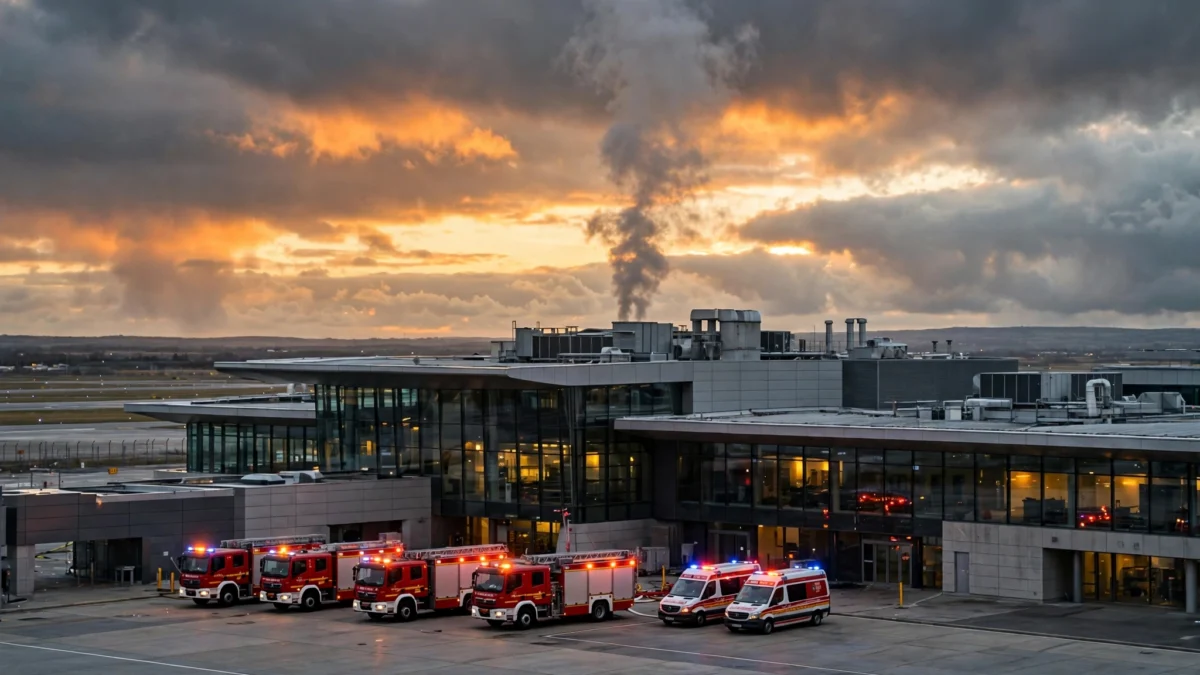
A projectile struck a passenger terminal at King Khalid International Airport in Riyadh on Sunday, the Saudi-led coalition fighting Yemen’s Houthi rebels said, a day after a missile attack on the same airport killed 12 people and wounded more than 300.
The coalition said an unidentified projectile hit Terminal 4 and started a fire, while air defences intercepted and destroyed a loitering cruise missile in the vicinity of the airport, according to coalition spokesman Major General Turki al-Maliki, as reported by The Times. Saudi authorities said there were injuries in the latest attack on the airport’s Terminals 3 and 4 complex, which handles domestic flights, the Associated Press reported. Officials did not give a number, and there was no immediate claim of responsibility for the Sunday strike.
AFP journalists heard a powerful explosion in central Riyadh on Sunday, while three residents in the north of the city later reported hearing another blast, according to the news agency. The cause of the explosions was not immediately clear.
The airport, which has been closed since Saturday’s attack, remained shut on Sunday while emergency crews responded and the damage was assessed. Saudi authorities extended the airport’s closure and moved schools in the capital online until Thursday, according to reporting carried by World Right Now, sourced from The Guardian.
Sunday’s strike came amid a fast-moving retaliation cycle. Shortly before the latest attack in Riyadh, the Houthis said the airport in the rebel-held Yemeni capital of Sanaa had been struck again and blamed the Saudis, the Associated Press reported. The Houthis also said Saudi strikes hit Sanaa on Sunday, reporting that a home was hit, a child killed and six other people injured — figures offered by the Houthi side that could not be independently verified.
The Houthis renewed warnings to airlines, travellers and airport staff to stay away from Saudi airports and Saudi airspace, excluding Mecca and Medina, saying further attacks would follow if Saudi military action in Yemen continued, according to the same Guardian-sourced reporting. The group had already claimed responsibility for earlier attacks this week, according to the Associated Press.
Netanyahu, Turkey and the United States react
Israeli Prime Minister Benjamin Netanyahu condemned the attack on the Riyadh airport on X, writing that he condemned it “in the strongest possible terms” as a “horrific terrorist attack” and extending Israel’s “deepest condolences” to the families of the victims, according to The Times.
Turkey’s foreign ministry called the Houthi attack on Riyadh’s international airport “deliberate”, saying it was aimed at “civilian infrastructure and innocent civilians” and describing it as “a flagrant violation of international law”, The Times reported. The ministry called for “actions threatening regional security and stability” to stop immediately.
The United States embassy in Saudi Arabia “strongly” recommended that all American citizens avoid the Riyadh airport and surrounding areas, posting on X: “Please take extreme caution when using all major airports in Saudi Arabia. We recommend checking your flight departure status directly with the airline and with the airport.” The embassy said its employees in the region would need special authorisation to use King Khalid international airport in Riyadh as well as the airports in Jeddah and Dammam, according to The Times.
There was no immediate White House comment on Sunday, the Associated Press reported. That silence stood out after a Saturday in which President Donald Trump told reporters the United States might join Saudi strikes against the Houthis — “We may,” he said — and Secretary of State Marco Rubio issued a Saturday-night statement condemning the earlier attack, including one that left an American citizen dead, according to the Washington Examiner.
What happened on Saturday
Saturday’s missile strike hit the Terminals 3 and 4 complex at King Khalid International Airport, killing 12 people and wounding 309, according to Saudi Arabia’s General Authority of Civil Aviation. The dead included four Saudi citizens, two Bangladeshis and one person each from the United States, Palestine, Egypt, Jordan, Syria and Sudan, Saudi authorities said. Several of the wounded remained in critical condition, and hospitals across Riyadh summoned additional medical staff.
The Saudi-led coalition called the Saturday attack a “war crime” and vowed a “firm” response. It was the deadliest attack in any Gulf Arab country since the broader conflict with Iran began in February, according to the Associated Press.
The strikes closed the airport, forced flight cancellations, delays and diversions, and entrances to the airport were blocked. More than 600 flights were cancelled on Sunday as the closure dragged on, according to data cited by CNN. Earlier in the week, Lufthansa and Air India had already suspended flights to the region after earlier attacks.
The weekend attacks followed a week of escalating Houthi strikes on Saudi airports, including an attack on Abha International Airport that left two people dead. The Wall Street Journal reported that Saudi Arabia has pressed the United States to intervene directly in the fighting, while the Trump administration has so far declined — a dynamic that Sunday’s second strike puts under fresh pressure.
Analysis: Why It Matters
Two strikes on the same airport complex within about 24 hours change the character of this campaign. A single missile strike can be read as a message, a probe, even a lucky shot. Back-to-back strikes on Terminals 3 and 4 are something else: a demonstration that the kingdom’s most sensitive civilian infrastructure can be reached not once but repeatedly, and that the reach is now a matter of routine rather than surprise. That is the point the Houthis want every airline, insurer and government watching the region to absorb — and it explains why the group keeps directing its warnings at commercial aviation rather than at military targets.
The interception reported on Sunday adds a second, less obvious dimension. Air defences caught a loitering cruise missile in the airport’s vicinity — proof that the defensive shield works, at least sometimes. But a projectile still got through to Terminal 4 and started a fire. That is the arithmetic of missile defence: the defender must intercept everything; the attacker needs only one leaker. Over time, that asymmetry favours whoever can sustain the tempo. If the Houthis can keep launching, even a strong defence record will produce occasional penetrations — and each penetration lands on camera, in the news cycle, and in the risk models of the airlines.
Civilian airports are a deliberate choice, and the choice is revealing. Striking oil terminals or military bases would be a conventional war of attrition; striking passenger terminals produces something more immediately political. Hundreds of cancelled flights, an embassy telling its own citizens to avoid the capital’s airport, schools moved online — that is visible disruption that touches ordinary life and business calendars. The World Petroleum Congress is still scheduled to proceed in Riyadh, but the question hanging over it now is not whether the venue is ready but whether delegates and executives will fly in. A strike that kills no one on a given Sunday can still cost a kingdom money, confidence and prestige.
The retaliation cycle is also compressing. The Houthis say Sanaa was hit on the same day, and a Saudi-led coalition that has already promised a “firm” response will be under enormous pressure to show it — especially after labelling the Saturday attack a war crime. When strike and counter-strike happen within the same news cycle, the space for quiet de-escalation shrinks. Each side’s response becomes the next side’s justification, and mediators who might have worked the phones over days now have hours.
Then there is the American clock. President Trump’s “We may” on Saturday was deliberately non-committal, and the Wall Street Journal’s reporting that the kingdom pressed Washington to intervene directly while the administration declined suggests a genuine policy argument underway inside the US government. Every new attack tightens that argument. Refusing to join strikes looks more conspicuous — and more costly in alliance terms — after a second airport hit in two days. But joining them would mean the United States taking ownership of a widening air war over Yemen and the Red Sea corridor, with all the oil, shipping and escalation risks that carries. Sunday’s strike does not resolve that dilemma; it makes it more urgent.
Finally, the broader energy picture cannot be ignored. These attacks unfold against the Iran war that began in February, the tanker war spreading through the Strait of Hormuz and the Gulf of Oman, and crude prices that have been on edge for weeks. Riyadh’s airport is hundreds of kilometres from the oil terminals, but the region’s risk premium does not distinguish carefully between a struck airport and a threatened refinery. The Houthis, Iran and the markets all understand the same thing: in this conflict, disruption is the weapon, and geography is secondary.
What to Watch Next
- The coalition’s retaliation. Major General al-Maliki’s “firm” response promise now has two attacks to answer. Watch whether the response targets Houthi launch infrastructure in Yemen, and whether the Sanaa strikes the Houthis reported were the start of it or a separate action.
- Trump’s decision. The president said Saturday the US was evaluating joining Saudi strikes. A second airport hit will force that decision onto the timetable — and any movement, in either direction, will be a story in itself.
- The airport’s reopening. With the closure extended and schools online until Thursday, the length of the shutdown will signal how confident Saudi authorities are that the attack sequence has ended — or that it has not.
- Airline advisories. The Houthis are warning airlines away from Saudi airports, and the US embassy has restricted its own staff. If major international carriers suspend Riyadh services, the economic and reputational damage compounds quickly.
- The World Petroleum Congress. Still on the calendar in Riyadh, and now the most watched event in the Gulf: whether it proceeds normally will be read as a verdict on the kingdom’s security narrative.
Sources
- Associated Press — Passenger terminal at Riyadh airport is struck again, a day after 12 were killed
- The Times — Saudi Arabia attacks latest: Airport hit second time after 13 killed in Houthi strike
- World Right Now — Riyadh airport hit again after deadly Houthi missile attack (sourced from The Guardian)
- Washington Examiner — American citizen among dozen dead in latest Houthi attack on Riyadh airport, Rubio says

About the Author — Abdul Mannan
Related Articles
Saudi-Led Coalition Calls Riyadh Airport Strike a “War Crime” and Vows “Firm” Response as 627 Flights Are Cancelled
The Saudi-led coalition has branded Saturday's deadly missile strike on Riyadh's international airport a war crime and promised…
Houthi Missile Strike on Riyadh Airport Kills 12, Wounds 309 in Deadliest Gulf Attack Since Iran War Began
A Saturday missile strike on King Khalid International Airport killed 12 people and wounded 309, the deadliest attack…
Israeli Strikes Kill at Least Five in Gaza on First Anniversary of US-Brokered Ceasefire
Israeli strikes killed at least five Palestinians in Gaza City on Saturday — the first anniversary of the…