Miley Cyrus Marries Maxx Morando: The Girl Who Grew Up in Front of the World Finally Chooses Herself

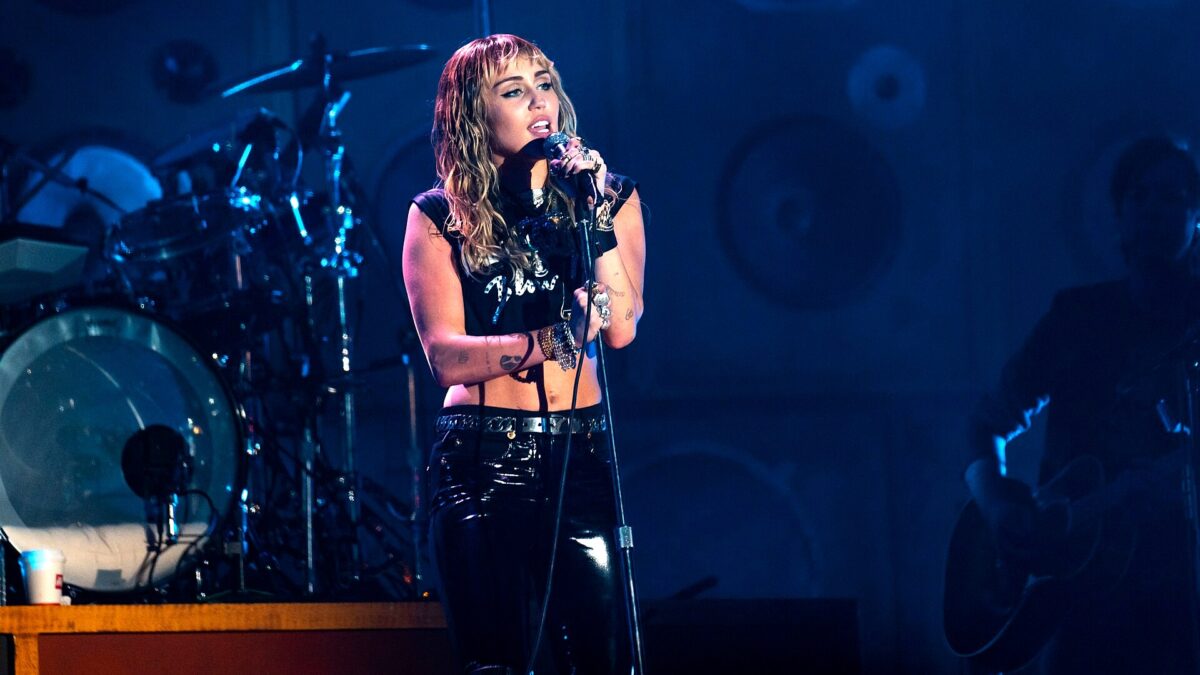
What happens when a girl grows up in front of the entire world — and then, one quiet Saturday in the desert, decides to stop performing for it?
On 21 November 2026, in the gardens of a private estate in Palm Springs, California, Miley Cyrus stood beneath an arch of white roses, wiped her eyes with a tissue, and married Maxx Morando. There was no stadium. No televised countdown. No red carpet. Around 140 guests, all dressed in black, watched a woman in a long-sleeved white satin gown say “I do” to a drummer the world barely knows — and the photographs that leaked out did something no publicity machine could ever buy. They made the whole planet stop and feel something.
I have watched this woman’s life the way the whole world has watched it — from a distance, through screens, through scandals and reinventions — and I tell you plainly: this wedding is not a celebrity story. It is a story about what it costs to become yourself when the world has already decided who you are.
The Wedding the World Almost Missed
The facts, as they have been confirmed by multiple sources, are these. Miley Cyrus, 33, and Maxx Morando, 28, married on Saturday, 21 November 2026, at a private residence in Palm Springs. The ceremony took place in the gardens of a home once owned by Frank Sinatra, beside a swimming pool, under an archway of white roses. The bride wore a long-sleeved white satin gown with a high neck and a daring low back that flared into a short train. She wore no veil. Her hair was swept into a chic updo. The groom wore a traditional black tuxedo.
The ceremony was officiated by Wayne Coyne, the frontman of the Flaming Lips — a choice that tells you everything about who Miley Cyrus is. She did not hire a celebrity minister or a television preacher. She asked a psychedelic rock musician, a friend, to marry her. The pictures published in the days that followed show her holding a tissue to her eyes during the vows, smiling through tears at her guests.
Her mother, Tish Cyrus, was there with her husband, Dominic Purcell. Her father, Billy Ray Cyrus, was there with his partner, Elizabeth Hurley, and Hurley’s son, Damian. Her sister Brandi’s fiancé, Matt Southcombe, was there. The family posed for photographs together — a family that the tabloids have spent years declaring broken, standing in one frame, in black, smiling.
The night before, on Friday, 20 November, the couple hosted their rehearsal dinner. The menu, inscribed with their initials “M + M” and the date “11.20.2026”, offered filet mignon, sherry cappuccino and hazelnut crème brûlée. It was intimate, deliberate, unhurried. Nothing about this weekend screamed for attention — and that is precisely why the whole world is talking about it.
Think about that for a moment. A woman who has spent twenty years being watched chose, for the most important day of her life, to be barely seen. The wedding was reported two days before it happened, the photographs came from paparazzi lenses and guests’ phones, and still the day belonged to her. In an age when celebrities sell their weddings to magazines for millions, Miley Cyrus gave hers away to no one. That is not an accident. That is a decision. And decisions like that are never made in a day. They are made over a lifetime.
From Destiny Hope to Miley
To understand this wedding, you must go back to the beginning — and the beginning is stranger than any fiction. She was born Destiny Hope Cyrus on 23 November 1992, in Franklin, Tennessee, the daughter of country singer Billy Ray Cyrus and Leticia “Tish” Cyrus. Her father called her “Smiley” because she smiled so much as a baby. Smiley became Miley. And Miley, at eleven years old, became the most famous child on earth.
Hannah Montana ran on the Disney Channel from 2006 to 2011, and it was not merely a television show. It was an empire — two number-one soundtracks on the Billboard 200, concert tours, merchandise, a franchise that turned a child into a brand before she was old enough to drive. The premise of the show now reads like a prophecy: a girl who lives a double life, ordinary schoolgirl by day, pop superstar by night, hiding her true identity behind a blonde wig. The whole world watched a child pretend to be two people. Nobody asked what it would cost her to figure out which one was real.
Her solo career began while the show was still running — the number-one albums Meet Miley Cyrus in 2007 and Breakout in 2008 — and by the time the show ended, she was nineteen years old and already a veteran of an industry that devours its young. Here is the truth the entertainment business never says out loud: we love child stars the way we love fireworks. We light them, we watch them blaze, and we are surprised when they burn.
History is full of these children. Judy Garland was given pills to keep her awake and pills to make her sleep, and the studio owned her body before she owned her name. Britney Spears was the girl next door until the world decided she was a cautionary tale. The pattern never changes: the child is loved for being innocent, then punished for growing up. Every child star faces the same wall — the day the audience realises the little girl is gone, and resents her for it.
Miley Cyrus hit that wall in 2013, and she hit it at full speed.
The Wrecking Ball Years
In 2013, she released Bangerz, an album that announced, in the loudest possible language, that Hannah Montana was dead. The singles “We Can’t Stop” and “Wrecking Ball” — her first number-one on the Billboard Hot 100 — were accompanied by an image that shocked the world: shaved hair, gold grills, a tongue out at the camera, a performance at the MTV Video Music Awards that became the most talked-about moment of the year. The world gasped. The world judged. The world could not look away.
I will not pretend that period was graceful. It was not. It was messy, provocative, and — I believe — entirely necessary. When a cage is built around you in childhood, you do not escape it politely. You break it. And breaking things is loud.
But here is what the moralists missed, then and now: the girl who swung naked on a wrecking ball was not destroying herself. She was destroying the doll the world had made of her. There is a difference, and it is the difference between ruin and rebellion. Every generation has its moment when a young woman refuses to stay the sweet girl in the photograph. In 2013, Miley Cyrus refused — and the price she paid was years of being called everything except her own name.
What followed was a decade of restless searching that the charts barely captured. She made a psychedelic album, Miley Cyrus & Her Dead Petz, in 2015 — free, strange, uncommercial, entirely hers. She made a country record, Younger Now, in 2017. She made a rock record, Plastic Hearts, in 2020. She tried on genres the way other people try on coats, and every time the critics asked the same question: who is the real Miley?
They were asking the wrong question. The real Miley was the woman doing the trying.
Flowers: The Anthem of a Woman Who Chose Herself
Then came “Flowers”. In January 2023, Cyrus released Endless Summer Vacation, and its lead single did something no one expected: it became the best-selling single of 2023, her second American number-one, and — in February 2024 — it won her the first Grammy Awards of her career. Record of the Year. Best Pop Solo Performance. After eighteen years in the business, after two number-one soundtracks as a child and a decade of reinvention as an adult, the industry finally handed her its highest honour — for a song about a woman who learns to love herself.
Listen to what that song actually says. “I can buy myself flowers. Write my name in the sand. Talk to myself for hours. Say things you don’t understand. I can take myself dancing. And I can hold my own hand. Yeah, I can love me better than you can.”
Those are not the lyrics of a pop star. Those are the words of a woman who has survived a marriage, a divorce, and a lifetime of being told who to be — and has decided, at last, that her own company is enough. The song was widely read as a response to her first marriage, to the actor Liam Hemsworth, whom she had met on the set of The Last Song in 2009, married in December 2018, and divorced in January 2020 after a separation announced in August 2019. Whether or not every line was about him does not matter. What matters is that millions of women heard it and recognised themselves in it. A song about self-love became the biggest song on the planet — because the whole planet was starving for it.
She won a third Grammy in 2025, for “II Most Wanted”, her country duet with Beyoncé. She released Something Beautiful, a visual album, the same year. She was named a Disney Legend. She received a star on the Hollywood Walk of Fame. The girl who had once been the industry’s cautionary tale was now, by every measure, its survivor.
And survivors, I have learned, do not rush. They choose carefully. They choose quietly. They choose well.
Maxx Morando: Five Quiet Years
Maxx Morando is 28 years old. He is a drummer and music producer who played in the American punk rock band The Regrettes and now plays in a band called Liily. He is not a movie star. He is not a tabloid fixture. He does not come with a franchise.
Cyrus met him in 2021. They were first romantically linked that year, and for five years they built something the old Miley would never have believed possible: a relationship conducted mostly in private. They were photographed together, of course — privacy is a relative word when you are Miley Cyrus — but the relationship never became a performance. There were no reality shows, no joint interviews, no brand deals built on their love. They simply stayed together, year after year, while the world looked elsewhere.
In December 2025, they confirmed their engagement when Cyrus debuted her ring at the premiere of Avatar: Fire and Ash in Los Angeles. The ring, designed by Jacquie Aiche, was estimated to be worth between $70,000 and $150,000. The world noticed the diamond. It missed the point. The point was not the ring. The point was that after five years, a woman who had been engaged, married and divorced in the full glare of the cameras had chosen to say yes again — this time on her own terms, in her own time, to a man who had never asked her to be anyone but herself.
Five years. Think about that. In an industry where celebrity relationships are measured in months, five quiet years is a revolution. It is the difference between falling in love with a spotlight and falling in love with a person.
Why This Wedding Matters
You may ask me — and you would be right to ask — why a pop star’s wedding deserves two thousand words. It is a fair question. The world is on fire. Wars rage. Markets fall. Climate talks in Turkey have run into overtime. Three nuclear powers met in Shenzhen and agreed on almost nothing. Why should anyone care about a wedding in Palm Springs?
Here is my answer: because the way we love is the way we live. And because Miley Cyrus’s life is not a gossip story — it is a mirror held up to an entire generation of girls who were told to be sweet, to be small, to be grateful, and who are now, one by one, refusing.
Consider what this wedding actually was. A woman who was sexualised as a teenager by an industry that profited from it, who was mocked for her body and her choices for a decade, married the man she loves in a dress she chose, in a garden she chose, surrounded by the people she chose — and cried, openly, in front of everyone. There was no performance of perfection. The photographs show tears. Real ones. Not the airbrushed joy of a magazine spread, but the wet-eyed, tissue-in-hand truth of a woman who knows exactly what this moment cost her.
And consider the setting. The estate once belonged to Frank Sinatra — the greatest crooner of the twentieth century, a man who sang about doing it his way and meant it. There is a poetry in that which no publicist could have planned. Sinatra’s house, where the Chairman of the Board once held court, now hosted a wedding for a woman who spent twenty years learning to do it her way. History does not repeat itself, but it rhymes — and sometimes it rhymes in a garden in Palm Springs, under white roses, beside a swimming pool.
There is another detail I cannot stop thinking about. The guests wore black. All of them. At a wedding — the one occasion in Western life reserved for white — 140 people dressed in black, and only the bride wore white. It was, whether by design or instinct, a statement: this day belongs to one woman. Not to the brands, not to the cameras, not to the audience. To her.
And the family. Oh, the family. For years the tabloids have feasted on the Cyrus family — the divorces, the estrangements, the public spats between father and daughter. And then, on a Saturday in November, Billy Ray Cyrus and Tish Cyrus both stood in the same garden, with their partners, watching their daughter marry. I do not know what was said between them. I do not know what was forgiven. But I know this: a wedding is not only the joining of two people. It is the gathering of everyone who made them. And when a broken family gathers in one place and smiles for a photograph, that is not gossip. That is grace.
The Girl Who Grew Up — On Her Own Terms
Two days after her wedding, on Monday, 23 November 2026, Miley Cyrus turns 34. She was born Destiny Hope Cyrus — Destiny, because her parents believed she was destined for greatness; Hope, because that is what parents give a child when they have nothing else to give. She has carried both names, and both burdens, for thirty-four years.
I think about the eleven-year-old girl in the blonde wig, singing to millions of children who believed she was two people at once. I think about the twenty-year-old on the wrecking ball, daring the world to look away. I think about the thirty-year-old at the Grammys, holding her first awards and saying, in effect, I did this myself. And I think about the thirty-three-year-old bride in Palm Springs, crying under white roses, who finally — finally — did not need the world to watch.
That is the arc. Not from innocence to scandal to redemption, the way the tabloids tell it. From performance to personhood. From a girl who was watched to a woman who chooses when to be seen. From “Flowers” — I can love me better than you can — to a vow spoken in front of 140 people in black: I choose you, and I choose myself, and I choose us, on my own terms.
There is a lesson here, and it is not only for celebrities. How many of us live our lives as performances? How many of us curate ourselves for an audience — our families, our employers, our followers — and forget that the audience was never the point? Miley Cyrus spent twenty years learning what most people never learn in a lifetime: that the only applause that matters is your own. That the only permission you need is yours. That a quiet wedding in a desert garden can be louder than a stadium, because it is real.
So I will not end this column with gossip. I will end it with a question, the way every honest column should end. Look at your own life — not the life you show the world, but the life you live when no one is watching. Are you living it for the audience, or for yourself? Are you still wearing the wig, or have you finally taken it off?
Miley Cyrus took hers off a long time ago. On Saturday, in Palm Springs, she simply made it official. And somewhere, in a garden that once belonged to Sinatra, under an arch of white roses, a girl who was born Destiny Hope finally became what her name always promised: a woman of destiny, and a woman of hope. Not the world’s. Her own.
Sources & References
- PEOPLE — “Miley Cyrus Marries Maxx Morando in Palm Springs Wedding”
- Hello! Magazine — “Miley Cyrus marries Maxx Morando: inside the singer’s intimate and emotional Palm Springs wedding”
- Entertainment Weekly — “Miley Cyrus marries Maxx Morando after 5 years of dating”
- Page Six — “Miley Cyrus marries Maxx Morando in intimate Palm Springs wedding”
- InStyle — “Miley Cyrus Stuns in Backless Wedding Dress to Marry Maxx Morando in Intimate Ceremony”
- Encyclopaedia Britannica — “Miley Cyrus”
- Wikipedia — “Miley Cyrus”

About the Author — Abdul Mannan
Related Articles

The Week the World’s Money Panicked: Nine Trillion Dollars Gone and the AI Dream on Trial
Nine trillion dollars vanished in a week. The Nasdaq suffered its worst week since 2020, Nvidia lost $2.2…

The Pentagon Opened the UFO Vault Again — and the Real Story Is What It Still Will Not Say
On 20 November 2026 the Pentagon released its eighth batch of declassified UFO files: 43 records, three military…
Britain Knocks on Europe’s Door Again: The 100,000 Young People Who May Undo Brexit
She was twelve when Britain voted to leave the EU — too young to vote, old enough to…