Saudi Arabia Intercepts Three Houthi Ballistic Missiles as Air-Raid Sirens Sound Over Riyadh

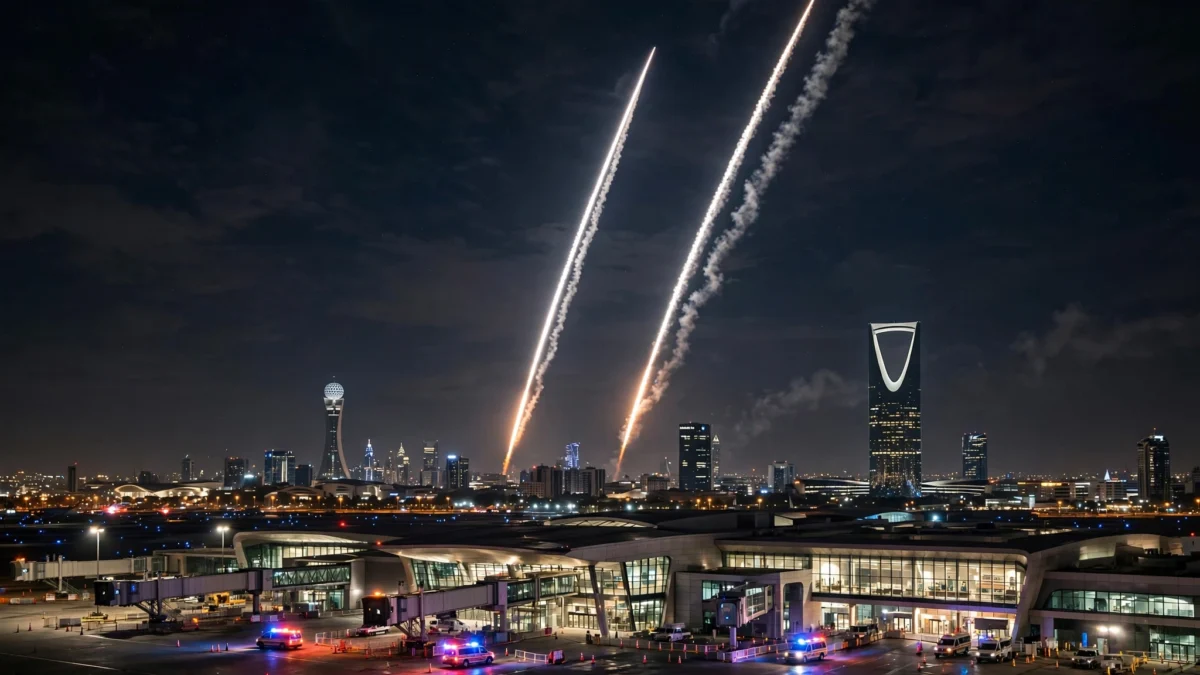
Saudi Arabia said on Monday evening it had intercepted and destroyed three ballistic missiles launched by Yemen’s Houthis, as air-raid sirens wailed over the capital and residents heard explosions across the city — the latest salvo in a week of attacks that has killed at least 20 people and emptied the skies above Riyadh.
According to the Saudi-led military coalition fighting in Yemen, one missile was intercepted over Riyadh and two others were destroyed over Khamis Mushait, in the southwest of the kingdom. Coalition spokesperson Turki al-Maliki confirmed the interceptions in a statement, saying all three projectiles were brought down before they could reach their targets.
The Houthi-controlled armed forces claimed responsibility for the attacks. The group’s military spokesman, Yahya Sarea, said in a statement on Monday evening that the group had targeted Riyadh’s King Khalid International Airport with a ballistic missile and sent a drone toward a military air base at Khamis Mushait. He also renewed the group’s warning to international airlines against operating flights to Saudi airports, repeating that the facilities were “unsafe,” with the exception of airports in the holy cities of Mecca and Medina.
Moments before explosions were heard in the capital on Monday night, residents received mobile-phone alerts warning of an aerial threat. Saudi civil defence later told residents the danger had passed.
The missiles struck at the rhythm of ordinary life. At Al-Awwal Park in Riyadh, Cristiano Ronaldo’s Al-Nassr side were due to kick off an AFC Champions League Elite match against Uzbekistan’s Neftchi Fargona at 9:15 p.m. local time when fans were told to stay calm and remain in their seats, according to USA Today. A Saudi military spokesperson told local media that forces had intercepted and destroyed a ballistic missile headed toward the capital, whose stadium sits on the campus of King Saud University. The match eventually began an hour late and finished 3-1 to Al-Nassr, with Ronaldo scoring the second goal.
An airport frozen shut
The interceptions came hours after Saudi aviation authorities announced that King Khalid International Airport would remain closed until further notice. A notice to air missions (NOTAM) indicates the airport will stay shut until at least October 17, according to CNN.
The airport — Saudi Arabia’s second-busiest, serving a city of about eight million people — has been suspended since Saturday’s attack, the deadliest strike on Saudi soil in more than a decade. According to Saudi authorities, the Saturday blast killed 13 people and wounded more than 300. The victims included four Saudis, two Bangladeshis, an American, an Egyptian, a Jordanian, a Syrian, a Palestinian and a Sudanese; the Indian Embassy in Riyadh said Sunday that an Indian citizen wounded in the attack later died. A second attack on Sunday killed a Pakistani resident and wounded 11 others, according to the Saudi civil aviation authority.
Footage of Saturday’s strike, obtained by Al Arabiya television, shows passengers waiting to board a flight when a blast sends part of the departure hall’s ceiling collapsing. People are seen clasping their hands over their heads and running for safety as dust and debris fill the terminal.
The Houthis also claimed to have targeted King Fahd International Airport in Dammam on Sunday. Saudi Arabia’s civil aviation authority confirmed the airport had come under attack on Sunday evening and said damage was being assessed.
Earlier in the week, Houthi attacks on the Riyadh airport between Tuesday and Thursday killed six people and wounded dozens, according to Saudi authorities — meaning at least 20 people have been killed in strikes over the past week, CNN reports.
The disruption has forced airlines across Europe and Asia to suspend services. Aviation analytics firm Cirium found that 99.7 percent of scheduled flights at the Riyadh airport were cancelled on Sunday, Reuters reported. Lufthansa Group has cancelled all flights to Riyadh until October 16, Air France-KLM has extended a suspension of services to and from the Saudi capital until the end of the month, and Abu Dhabi’s Etihad Airways extended cancellations affecting around 20 flights to Riyadh, Jeddah and Dammam on Monday and Tuesday.
Governments have scrambled to update travel guidance. The United States, United Kingdom, Spain and Canada are among the countries warning citizens against using the airport. The British government advised Sunday against all but essential travel to Jeddah and Dammam as well as all Saudi airports except Medina’s, suggesting citizens consider leaving Saudi Arabia by land. The US Embassy in Riyadh tightened guidance on Monday, saying US government employees now need special authorisation to use any airport in the country, urging American citizens to exercise “extreme caution” and noting that Americans had been detained for photographing the aftermath of recent attacks. The US Federal Aviation Administration told US airlines on Sunday to exercise caution flying to or over Saudi Arabia, citing safety threats and navigation-system interference.
The American question
Following Saturday’s attack, US President Donald Trump said he was considering joining Saudi strikes against the Houthis in Yemen, having previously resisted Saudi requests for direct military intervention. Asked outside the White House whether Washington planned to join the strikes, Trump said: “We may. We’re going to look at it.”
On Monday, Trump said he had spoken with Saudi Crown Prince Mohammed bin Salman, without elaborating on the conversation, and described the Houthis as “misbehaving very badly.” He added: “They’re able to defend. The Saudis are good fighters. But I think the attack was a terrible thing.” Last month, Trump rejected two appeals from the crown prince for US strikes against the Houthis, according to CNN.
The United States agreed to a ceasefire with the Houthis after a month-long American bombing campaign, and neither side has appeared eager to resume that conflict. US Secretary of State Marco Rubio confirmed an American citizen was among those killed in Saturday’s attack, saying it showed “a blatant disregard for innocent civilian life.”
Saudi Arabia’s Gulf neighbours have condemned the attacks, and some have called for unified action. “Our security is indivisible,” said UAE presidential adviser Anwar Gargash on Monday, arguing that targeting Saudi Arabia “undermines the security of the UAE and all Gulf states” and that there was a “pressing need to revive joint Gulf action” in security and defence.
Strikes and counter-strikes overnight
The Houthis said the airport strikes were retaliation for an intensified Saudi air campaign in Yemen. The group said on Monday that Saudi warplanes and missile units had carried out 119 attacks over the previous 24 hours, claiming these had killed at least 14 civilians, including women and children — a claim CNN said it could not independently verify.
Overnight into Tuesday, Houthi-run al-Masirah television reported that two airstrikes hit the rebel-held Red Sea island of Kamaran and a third struck Qanawis district, about 55 kilometres northwest of the port city of Hodeida, with further strikes in Jawf province bordering Saudi Arabia. Al-Masirah blamed Saudi Arabia for the strikes, though Riyadh did not immediately comment, the Associated Press reported. The rebels also claimed to have shot down a Saudi drone over the northern stronghold province of Saada.
Casualty claims from inside Yemen are difficult to verify independently. Yemen’s Saudi-backed military said Monday its forces had carried out 1,879 attacks on Houthi targets in recent hours and killed about 950 fighters. The Houthi-run Health Ministry said Monday that 107 people had been killed and 278 wounded, most of them women and children, by Saudi attacks across 13 provinces since September 3. CNN said it could not independently verify either side’s figures.
How the war reignited
The civil war in Yemen flared up this summer and intensified last month after years of relative calm. According to CNN, the latest escalation began in July, when Saudi jets struck the runway of Sanaa airport to prevent a Houthi delegation returning from Iran from landing. In retaliation for a Saudi blockade on the Yemeni capital, the Houthis announced they would target Saudi shipping in the Red Sea and began a campaign of missile attacks against Saudi infrastructure, including oil refineries. Last month, the group conducted a lightning offensive along Yemen’s Red Sea coast, capturing the port of Mocha and closing in on Taiz, Yemen’s third-largest city.
Saudi Arabia, which re-entered Yemen’s civil war this year to push the Houthis back from the vital Bab al-Mandeb Strait and stop their gains, has for 11 years tried to contain the conflict on its southern border through both force and diplomacy — first waging war against the Houthis, then pursuing talks including with their backer, Tehran. According to Iran’s foreign ministry, Tehran has offered to facilitate dialogue between Riyadh and the Houthis, though Saudi state media’s account of a Sunday-night call between the Saudi and Iranian foreign ministers made no mention of the offer.
Analysis: Why It Matters
The siren over Riyadh is the story
The intercepts themselves are routine in one sense — Saudi air defences have been swatting Houthi missiles out of the sky for years. What is new is the texture of the week: sirens in the capital, phone alerts to eight million residents, a Champions League match held hostage in its tunnel for an hour. Riyadh has not lived like this in a decade. The sound of an air raid over the seat of the crown prince’s transformation project does political work that no intercepted missile can undo.
Interception is not deterrence
There is a brutal arithmetic here. Every intercepted missile is a victory of hardware; every launched missile is a defeat of strategy. The Houthis, with Iranian assistance, have built an arsenal of ballistic weapons and drones capable of reaching anywhere in the kingdom, according to CNN. Each launch costs the group relatively little and forces Saudi Arabia to expend expensive interceptors — and, according to the Wall Street Journal, the kingdom is running low on them and has been repositioning batteries to protect Riyadh. A defence that works perfectly every night but depletes itself is a clock running down.
Washington’s “may” is the loudest word in this war
Trump’s “we may” — delivered after rejecting two earlier Saudi appeals for strikes — is deliberately ambiguous, and ambiguity is its point. It tells the Houthis that American restraint is conditional without committing Washington to anything, and it tells Riyadh that American help remains possible without promising it. But the ambiguity cuts both ways: the US-Iran war has already begun, and any American strike on the Houthis risks folding Yemen into a conflict that began in the Gulf in February. Both Washington and the Houthis, after their month-long exchange and ceasefire, know exactly how that movie ends.
The Vision 2030 bill
The fighting poses a direct challenge to Crown Prince Mohammed bin Salman’s project of turning the oil kingdom into a centre for tourism, finance and sport. The airport shutdown, the empty skies, the travel advisories telling British citizens to consider leaving by land, BP and Shell executives withdrawing from a major energy event — these are the tangible invoices of the week. A country courting global capital cannot also be a country where the Champions League kickoff is delayed by a missile alert. The Houthis appear to understand this perfectly; that is precisely why the airport, not the oil terminal, is the target.
What to watch next
- Interceptor depth. Whether the Houthis can sustain a nightly launch tempo long enough to stress Saudi air-defence stocks — and whether Washington quietly replenishes them.
- The October 17 line. Whether King Khalid International Airport reopens on schedule — the NOTAM date is now the war’s first unofficial deadline.
- Trump’s decision. Whether “we may” becomes strikes — and whether any American action stays limited to the Houthis or bleeds into the wider US-Iran conflict.
- The mediation track. Whether Iran’s offer to facilitate dialogue gets a public Saudi response, or whether the road map for Yemen stays buried.
- The airline warning. Whether carriers keep Riyadh suspended past October, and how long a closed capital airport takes to reopen once the missiles stop.
Sources
- CNN: Saudi Arabia intercepts three missiles as capital’s international airport remains closed
- Bloomberg (via Moneyweb): Saudi Arabia intercepts new Houthi attacks
- Reuters: Saudi Arabia faces new missile and drone fire after major attacks on airports
- Associated Press: Houthi rebels say multiple airstrikes targeted them in Yemen
- USA Today: Ronaldo, Al-Nassr see Champions League game delayed as missile attacks continue

About the Author — Abdul Mannan
Related Articles
Iran Offers to Mediate Between Saudi Arabia and the Houthis as Airport Attacks Escalate
Tehran says it is ready to facilitate dialogue between Riyadh and the Houthis after a week of deadly…
Houthi Campaign Widens to Dammam as Riyadh Death Toll Rises to 13, Trump Weighs US Strikes
King Fahd International Airport in Dammam came under attack on Sunday evening as the Houthi campaign spread 400…
Riyadh Airport Hit Again: Second Strike in Two Days Sets Terminal 4 Ablaze as Air Defences Intercept Cruise Missile Nearby
A projectile struck Terminal 4 at Riyadh's King Khalid International Airport on Sunday, a day after a missile…